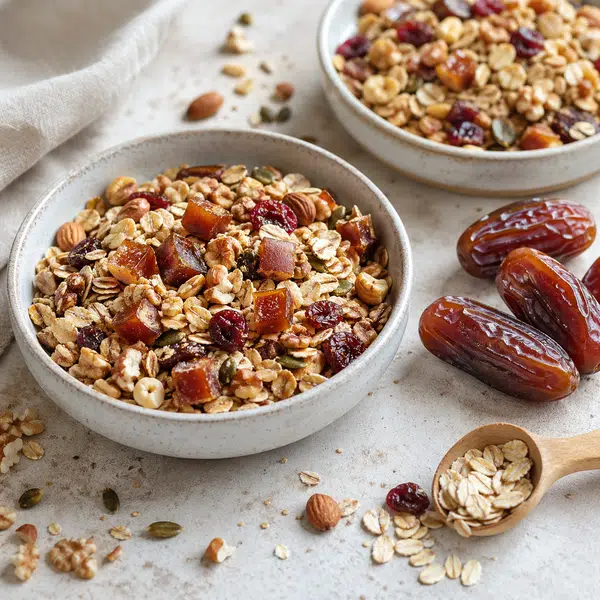
Granola blends
Dates are used in premium granola where manufacturers want soft fruit contrast against toasted oats, seeds and nuts, with a more natural sweetness profile.
A practical industrial and commercial guide to Tunisian dates in breakfast cereals, granola, muesli, snack mixes and fruit-nut blends, with focus on format selection, line compatibility, moisture behavior and supply planning.
Breakfast and snack applications do not evaluate dates in the same way as retail whole-fruit programs. Industrial buyers care more about blend behavior, cut format, moisture control and repeatable processing performance.
Tunisian dates, especially Deglet Nour, are highly relevant in breakfast cereals, granola, muesli and snack mixes because they provide natural sweetness, soft chew, recognizable fruit identity and a premium ingredient story. In many blend systems, dates help create a fruit-forward profile without relying exclusively on more aggressively sweetened or heavily processed inclusions. This makes them particularly attractive for premium, better-for-you, natural and organic product lines.
From an industrial point of view, however, dates are not a simple plug-in fruit ingredient. Their softness, sugar profile and handling behavior mean they must be matched carefully to the production system. In dry cereal and snack applications, the wrong date format can cause clumping, uneven distribution, sticking to other inclusions or poor flow in processing and packing lines. This is why application-specific sourcing is far more useful than a generic price inquiry.
For some manufacturers, dates are used as visible inclusions in premium granola or fruit-nut mixes. For others, chopped or diced dates are needed for even dispersion in muesli or cereal blends. In snack clusters and soft-blended products, the date may also contribute to the texture logic of the finished product. These different use cases require different commercial offers because the required date format, handling profile and quality expectations are not the same.
Commercially, successful breakfast and snack date programs are built around a clear brief: intended application, inclusion size, target texture, acceptable stickiness, certification scope, pack format and annual volume. Once those points are aligned, the supplier can structure the offer around the actual process need rather than around a generic fruit description.
Industrial demand usually falls into several practical formats, each with different technical and commercial expectations.
Dates are used in premium granola where manufacturers want soft fruit contrast against toasted oats, seeds and nuts, with a more natural sweetness profile.
Chopped or diced dates can help create visible fruit distribution and recognizable sweetness in muesli and breakfast cereal blends.
Dates fit well in snack assortments where the buyer wants a soft and naturally sweet component to complement crunchy nuts and seeds.
In selected cluster systems, dates can contribute not only inclusion value but also part of the softness and cohesion of the final product.
Dates often suit products positioned around natural sweetness, fruit-based snacking and cleaner ingredient communication.
Retail and foodservice toppings that combine fruit, nuts and seeds can use dates as a premium and recognizable fruit ingredient in mixed packs.
The right format depends on whether the manufacturer needs strong fruit visibility, even distribution, easier dosing or lower clumping risk.
Suitable in selected premium snack assortments or controlled fruit-nut mixes where larger fruit pieces are part of the finished product appeal, although they are less common in highly automated cereal blending systems.
Often preferred where buyers want better dispersion, more predictable inclusion ratio and easier handling across cereal, muesli and granola production lines.
Useful when a more natural-cut appearance is preferred, especially in artisanal-style or premium mix concepts, while still supporting practical processing.
Some industrial users define cut size more precisely based on dosing systems, blend appearance, consumer spoonability or pack distribution behavior.
Manufacturers often require a date profile designed specifically for inclusion use rather than general whole-fruit trade supply.
For regular users, supply is usually structured as a repeat industrial ingredient program matched to production rhythm rather than as occasional spot purchasing.
For breakfast and snack applications, the most important issues are usually handling behavior, texture balance and blend compatibility.
Dates need the right balance between softness and manageable handling. Excessive tackiness may increase clumping or disrupt blend uniformity, while overly dry fruit can reduce eating quality.
For diced or chopped formats, size consistency matters because it affects dosing accuracy, pack appearance and consumer experience in spoonable or hand-held mixes.
The fruit should remain workable in the mix and not create excessive settling, agglomeration or concentration in isolated areas of the finished pack.
Dates are often selected because they add chew and softness to otherwise dry or crunchy systems, but this advantage only works if the format suits the line and the recipe.
Tunisian dates provide recognizable sweetness and fruit depth, so batch consistency matters for branded products with fixed sensory expectations.
Because breakfast and snack mixes are typically ready-to-eat, industrial buyers usually align microbiological expectations and food safety criteria early in the approval process.
In breakfast and snack systems, moisture is not only a technical point. It affects yield, line efficiency, blend behavior and complaint risk.
Date inclusions can create strong product value in breakfast and snack mixes, but only if the moisture profile is appropriate for the application. If the fruit is too soft or sticky, it may attract fines, clump with grains or nuts, and reduce the visual cleanliness of the blend. It may also create feeding or dosing challenges during production. If it is too dry, the product may lose the soft and satisfying fruit texture that makes dates commercially attractive in the first place.
This balance matters financially. A cheaper date offer may become more expensive in actual use if it leads to more downtime, more rejected blend inconsistency, higher cleaning frequency or weaker consumer acceptance. Serious buyers therefore usually focus on in-use performance rather than nominal product price alone. For recurring breakfast and snack programs, the right moisture and handling profile often becomes one of the most important buying criteria.
Not every breakfast or snack line handles dates the same way, so the product brief should match the actual manufacturing route.
In granola, dates are often chosen for visual appeal and soft contrast against crisp baked components. In muesli, they are valued for fruit identity and sweetness in spoonable breakfast applications. In fruit-and-nut snack blends, they help create a more indulgent and satisfying texture alongside harder inclusions. Each of these systems places different stress on the fruit. A cut format that performs well in a low-shear muesli blend may behave differently in a granola line or in a high-throughput snack mix packing operation.
That is why industrial approval should usually consider the actual product route rather than only the ingredient sheet. Buyers typically benefit from defining whether the date is expected to remain fully visible, distribute evenly in every portion, support a softer eating profile or simply complement other fruit and nut ingredients. Once that role is defined clearly, the supplier can align the most suitable format and commercial structure more accurately.
Industrial users generally compare more than product availability. They compare how efficiently the date inclusion will work in production and in the finished pack.
Buyers usually get better results when the inquiry states clearly whether the dates are needed as whole, diced or chopped industrial inclusions.
Annual or seasonal demand estimates help suppliers build a steadier program and improve continuity across repeat shipments.
The date profile suited to premium retail packs may differ from the one best suited to industrial cereal or snack blending.
Pack format, liners, pallet logic and warehouse handling all matter because breakfast and snack factories often need efficient material intake.
Documentation, labeling and certification priorities differ by market and customer channel, so export structure should match the final destination.
Branded mix programs usually require consistent ingredient performance across multiple lots, not just an acceptable first shipment.
Industrial date supply works best when the packaging supports both transport protection and efficient factory handling.
Common for industrial users that need hygienic, stackable and warehouse-efficient inbound supply in recurring programs.
Whole, diced and chopped dates may not behave identically in storage and intake, so pack structure should reflect the product format being shipped.
Stable palletization and carton identification support receiving accuracy, stock rotation and traceability in formal manufacturing environments.
For breakfast and snack manufacturers, packaging is an operational issue as much as a logistics one. The right pack size, liner quality and pallet pattern can simplify unloading, internal movement and production feeding. Where the business depends on multiple repeat shipments through the year, these details become commercially significant because they influence efficiency at destination as much as protection during transit.
Industrial buyers usually need a more formal approval process than general fruit traders because the product goes directly into ready-to-eat consumer mixes.
The brief should define cut style, format, pitted requirement if relevant, sensory expectations, pack structure and intended industrial use.
Because breakfast and snack products are usually consumed without further kill step, microbiological suitability should be aligned from the start.
Formal lot identification supports customer audits, internal quality systems and complaint handling in modern food manufacturing.
Organic and other customer-required certifications should be clarified early when they are commercially central to the final product position.
Dates are often chosen because they combine ingredient recognition, sweetness and texture value in one fruit component.
Dates can support a fruit-led sweetness profile that fits premium and better-for-you mix concepts.
They add chew and softness that can balance crisp cereals, toasted granola components, nuts and seeds.
Tunisian dates offer a familiar and commercially strong ingredient story that can add value in branded breakfast and snack products.
Whole, diced and chopped formats allow the ingredient to be adapted to different blend architectures and commercial channels.
Most sourcing problems are avoidable when the application is defined clearly before the supplier structures the quotation.
Whole, diced and chopped dates behave differently in breakfast and snack systems, so the wrong format can reduce efficiency and consistency.
A date profile that looks acceptable on paper may still create clumping or poor blend performance if stickiness is not matched to the application.
A cheaper date line may not deliver the same in-use value if it increases downtime, sorting effort or finished pack inconsistency.
Changing packing needs too late can complicate shipment planning and reduce operational efficiency in recurring supply programs.
Without demand visibility, suppliers have less ability to build stable annual programs around the buyer's true consumption pattern.
If the technical approval is too general, the product may later underperform in dosing, distribution, texture or pack appearance.
A strong breakfast and snack date inquiry should make the industrial role of the fruit clear from the beginning.
Confirm whether the requirement is for pitted whole dates, diced dates, chopped dates or another inclusion-oriented format for cereal or snack use.
Share the target application, desired cut size, handling expectations, acceptable stickiness, food safety requirements and any critical line concerns.
Clarify expected volume, pack format, target market, certification scope and whether the inquiry is for a trial, recurring order or annual supply program.
These are the points that usually matter most for industrial buyers using Tunisian dates in breakfast and snack mixes.
Tunisian dates should be sourced according to how they will function in cereal, granola, muesli or snack blends, not as a generic fruit line.
Whole, diced and chopped date formats can behave very differently in industrial mixing, dosing and finished pack distribution.
The right balance of softness and manageability can influence line efficiency, blend quality and complaint risk more than headline product price alone.
Forecast visibility and stable specifications generally support better repeat performance than reactive spot buying for breakfast and snack manufacturing.
Short answers for importers, breakfast cereal manufacturers and snack mix processors.
Buyers should clarify end use, target market, required format, whole or pitted requirement, cut size expectation, certification profile and preferred pack format before requesting a quotation.
Because breakfast cereals, granola, muesli and snack mixes place different demands on Tunisian dates than confectionery, bakery or retail whole-fruit programs. Format, stickiness, cut consistency, moisture behavior and blend compatibility all affect the commercial result.
Pitted dates, diced dates, chopped dates and other inclusion-oriented formats are the most relevant, depending on whether the fruit is used in granola, muesli, cereal blends, snack clusters or fruit-and-nut mixes.
In many cases yes, provided the fruit profile, certification requirement, process route and packing structure are aligned with the customer requirement and the available sourcing program.