Retail packaging logic
Retail packs are designed for shelf presentation, consumer trust, product visibility, brand positioning, pack convenience and compliance with market-facing label requirements.
A practical commercial guide to foodservice and retail packaging for Tunisian dates, covering pack formats, labeling logic, carton planning, pallet structure and export execution for different sales channels.
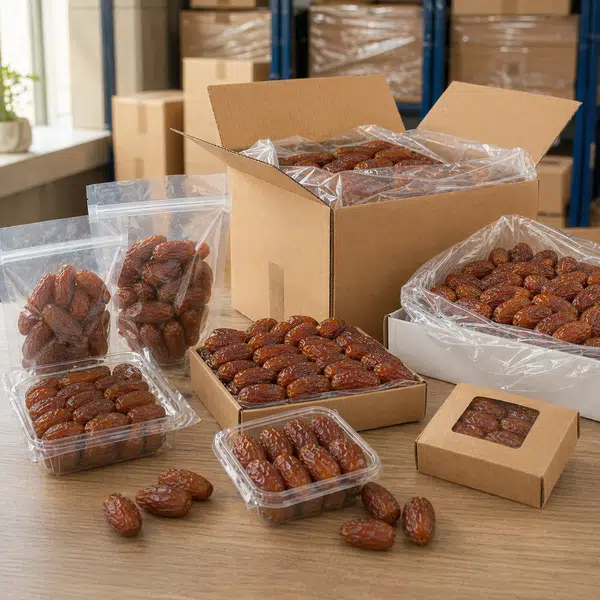
Tunisian dates may come from the same origin, but the right packaging structure changes significantly depending on whether the product is destined for retail shelves or foodservice use.
Tunisian dates, especially Deglet Nour, are sold through several channels at once, including premium retail, private label, wholesale distribution, foodservice and industrial supply. Because of this, packaging decisions should not be treated as a minor detail added after product approval. In many cases, pack format is one of the main commercial decisions because it affects presentation, labeling, storage, handling, freight efficiency and the overall usability of the product in the destination market.
Retail buyers usually need packaging designed for shelf impact, consumer confidence and repeatable presentation. They focus on consumer unit size, material selection, label layout, barcode placement, visual appeal, pack integrity and how the product appears in the retail environment. Foodservice buyers, by contrast, usually think more about kitchen use, back-of-house handling, open-and-use practicality, storage efficiency, portion economics and product consistency once the pack is opened.
This difference changes the entire quotation structure. A retail-ready Tunisian date program may involve printed consumer units, shelf-ready cartons, multilingual labeling and stricter presentation control. A foodservice program may instead prioritize durable larger units, easier carton handling, kitchen-friendly pack sizes and operational labeling rather than high visual retail appeal. Both may use similar fruit, but they are not the same packaging program.
For importers, distributors, retailers and foodservice suppliers, the best commercial outcome usually comes from defining the channel first and the packaging second. Once the intended route is clear, the supplier can align the right date grade, pack format, carton structure and document flow with much greater precision.
Retail packaging is consumer-facing. Foodservice packaging is operationally facing. That difference affects almost every packaging decision.
Retail packs are designed for shelf presentation, consumer trust, product visibility, brand positioning, pack convenience and compliance with market-facing label requirements.
Foodservice packs are designed for storage practicality, handling ease, kitchen use, portion efficiency and reliable performance in catering, horeca and institutional channels.
Retail packaging must usually sell the product visually, while foodservice packaging must usually support the user operationally after delivery.
Retail packs often require more detailed consumer-facing labeling, while foodservice labels are often more functional and logistics-oriented.
The correct retail format depends on shelf strategy, target market position, expected price point and whether the program is branded, private label or importer-led.
Retail programs begin with the right selling unit, because unit weight influences price perception, shelf fit and retail margin structure.
Clear windows, pouch structures, trays, cartons or combination formats may be selected depending on whether the product should emphasize premium appearance, practicality or value.
Premium retail programs usually require stronger visual consistency and more disciplined packaging execution than value or mass-channel programs.
Private label retail packs need packaging that supports artwork, coding, legal text, barcode logic and repeatable store-ready presentation.
Even retail-ready programs need export cartons and pallet structures that protect the consumer units while remaining efficient in warehouse and store supply chains.
Retail packaging should always be aligned with the destination market because language, label structure and commercial expectations vary from one market to another.
Foodservice packaging should be driven by product usage rate, storage conditions, handling rhythm and the operational environment in which the dates will be consumed.
Foodservice buyers typically focus on practical pack sizes that suit restaurants, hotels, catering operations, bakeries, pastry kitchens, buffet operators and institutional kitchens. The priority is usually not shelf appeal but ease of storage, simple handling, efficient opening, sensible portion sizing and consistent product condition after the pack is opened. These needs often point to larger units than retail, but the correct size still depends on actual consumption rhythm and operational workflow.
For example, a high-turnover catering business may prefer larger, more efficient foodservice units because the product is consumed quickly after opening. A smaller bakery kitchen or hospitality operator may need more moderate units to protect usability and reduce open-pack exposure. This is why the correct foodservice pack is not only about weight. It is about how the end user stores, opens, portions and rotates the product.
Good foodservice packaging programs also require strong outer carton logic. The pack should be easy to stack, receive and move in professional kitchens or distribution depots, while still protecting the dates during export. This makes carton durability, inner pack discipline and pallet efficiency commercially relevant even in non-retail channels.
The correct pack structure depends on whether the dates are being sold directly to consumers, supplied through foodservice distribution or prepared for mixed-channel programs.
Used where shelf presentation, consumer convenience and branded or private label positioning are the main commercial priorities.
Often selected where fruit presentation and pack stability are especially important in premium retail environments.
Suitable for operators that need efficient handling and practical storage rather than retail shelf impact.
Preferred where the importer or local distributor will later convert the product into retail or foodservice units in the destination market.
The packaging structure is part of the commercial offer, not a secondary technical detail.
Pouch quality, tray type, carton structure and print scope all influence the cost base and the overall commercial profile of the program.
Retail and private label programs become more complex when multiple languages, legal texts, barcode systems and country-specific details are involved.
Even strong consumer packs can underperform commercially if the export carton is inefficient, unstable or badly suited to pallet movement and warehouse handling.
Pallet structure affects container efficiency, warehousing and freight economics, so it should be fixed before recurring shipments begin.
Programs with unstable pack requirements are harder and often more expensive to execute than programs built around standardized packaging logic.
The wrong pack for the target channel can reduce sell-through, complicate handling or create unnecessary cost even if the dates themselves are fully acceptable.
Packaging programs become more reliable when label and compliance requirements are fixed before production rather than during final shipment preparation.
Retail packs usually need stronger focus on product naming, language, claims, barcode structure, lot coding and market-facing label clarity.
Foodservice packs are often more functional, but they still need clear identification, traceability and destination-appropriate labeling structure.
Private label projects require packaging and label details to be fixed early because artwork changes and coding corrections can slow execution significantly.
Where organic or other claims are commercially important, the packaging and document flow should be aligned consistently with the required certification profile.
In export trade, packaging and documentation are closely linked. A retail or foodservice pack may be physically ready, but shipment execution can still slow down if label content, document references or destination requirements are not aligned in advance. Serious buyers therefore usually treat packaging approval and compliance approval as one connected process.
The packaging format should match the commercial level of the fruit and the sales channel it is meant to support.
A premium retail Tunisian date program usually combines stronger fruit presentation with a more presentation-focused packaging structure. Better-looking fruit inside a weak consumer pack may not deliver the intended retail impact. On the other hand, using a premium retail pack for a purely foodservice or back-of-house application may add complexity without improving the commercial outcome. This is why pack format and fruit profile should always be discussed together.
In practical terms, buyers should align the grade of the dates, the pack style, the target price point and the intended market position in one commercial discussion. When these elements are aligned early, the packaging becomes a tool for reinforcing the sales objective rather than a source of cost confusion later in the project.
Most packaging problems come from unclear channel definition or trying to finalize pack decisions too late.
A pack designed to look attractive on shelf may be inefficient in kitchens, catering depots or professional back-of-house environments.
A practical bulk-oriented pack may still fail commercially if it does not support shelf presentation, consumer trust and retail-ready labeling.
Private label and branded retail projects often lose time when artwork, label language and barcode logic are not fixed early enough.
Focusing only on the inner unit without considering export cartons and pallet logic can weaken the whole packaging program operationally.
Too many pack variants in one program can reduce execution efficiency and make repeat supply harder to manage.
The right packaging decision should be based on how the product will actually be sold, stored and consumed, not only on general preference.
A strong packaging inquiry should define the channel, selling unit and execution requirements before price comparison begins.
State whether the requirement is for retail, private label, foodservice, wholesale repacking or a mixed-channel program so the packaging logic can be aligned correctly.
Confirm consumer or foodservice unit type, target pack size, carton structure, pallet expectations, label needs and whether the pack is branded or neutral.
Share annual volume, destination market, expected shipment rhythm, certification requirement and whether the inquiry is for a trial, launch or recurring annual program.
These are the main points buyers usually need before building Tunisian date packaging programs for retail and foodservice channels.
Retail focuses on shelf presentation and consumer confidence, while foodservice focuses on handling, storage and practical use in professional environments.
The correct pack is the one that supports how the dates will actually be sold, moved and consumed, not only how they look in isolation.
Carton design, pallet logic and export handling efficiency can affect the real value of the packaging program as much as the consumer or foodservice unit itself.
Programs with stable packaging, label and document logic usually achieve better continuity and fewer delays than those finalized late.
Short answers for importers, retailers, distributors and foodservice suppliers evaluating Tunisian date packaging programs.
Buyers should clarify end use, target market, desired grade, whole or pitted requirement, required certification profile and preferred pack format before requesting a quotation.
Because foodservice and retail date programs follow different packaging logic. Retail packs are shelf-facing and presentation-driven, while foodservice packs are usually handling-driven, portion-driven and operationally focused.
Retail packaging is designed around consumer presentation, labeling and shelf impact, while foodservice packaging is designed around kitchen use, storage practicality, portion efficiency and back-of-house handling.
In many cases yes, provided the fruit profile, certification requirement, packaging structure and destination market expectations are aligned with the buyer requirement and the available sourcing program.