Product format
Whole, pitted, retail-ready and bulk date programs may each require different packing and loading discipline depending on how the product will be handled later.
A practical commercial guide to how Tunisian dates should be packed, loaded, transported and stored so that export shipments arrive in commercially usable condition and remain stable through destination handling.
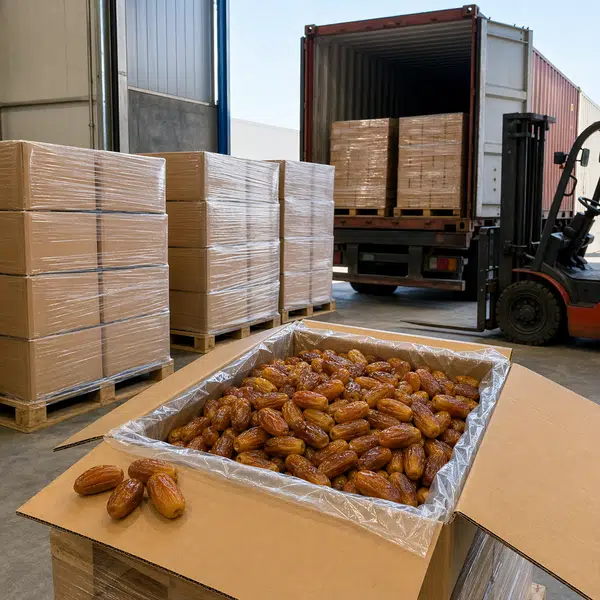
Dates are not sold only on origin and grade. Their commercial value also depends on whether they arrive, unload and store properly after export.
Tunisian dates, especially Deglet Nour, are traded through retail, private label, foodservice, wholesale and industrial channels. In all of these channels, product quality at origin is only part of the commercial equation. Packaging structure, pallet stability, loading discipline, transit handling and destination storage conditions all influence whether the product reaches the buyer in the same commercially acceptable condition in which it was packed.
For international buyers, this matters because a shipment can lose value without any change in origin specification. If cartons are compressed, if pallets shift, if container loading is inefficient, or if the product is stored poorly after arrival, the resulting damage may affect usability, presentation, repacking efficiency or downstream customer acceptance. In some cases, the issue is not a defective product but a weak logistics chain.
This is why container loading and storage advice should be part of the sourcing discussion, especially for annual programs and repeat export business. Buyers need to understand not only what they are buying, but how the product should move through the logistics chain. A good date program therefore links product brief, pack format, pallet logic, shipment conditions and warehouse handling into one practical framework.
Atlas approaches logistics as a commercial support function. The goal is not to overcomplicate shipments, but to reduce avoidable losses, protect repeatability and help buyers receive product that remains fit for its intended channel after transit and storage.
Most transit issues begin before the container door is closed. The strongest shipments are built on early alignment of product, packaging and handling logic.
Whole, pitted, retail-ready and bulk date programs may each require different packing and loading discipline depending on how the product will be handled later.
Carton strength, dimensions and internal packing logic should suit both export transit and the destination warehouse environment.
Stable pallet structure supports container safety, unloading control and stock movement after arrival.
Clear outer identification supports receiving, traceability and complaint handling, especially in multi-shipment annual programs.
The shipment should reflect whether the product is headed into retail supply, foodservice distribution, repacking or industrial use after arrival.
Shipment planning becomes stronger when both sides align expected transit rhythm and post-arrival storage reality before dispatch.
The most important loading goal is commercial protection: cartons should arrive stable, identifiable and operationally usable.
Pallets should be loaded in a way that reduces shifting risk during sea or land transit and supports safe unloading at destination.
Overloaded or poorly distributed stacks can damage cartons and reduce the value of the product even when the dates themselves remain edible.
Balanced container loading helps protect pack integrity, reduces movement during transit and supports more reliable discharge conditions.
Outer case and pallet markings should remain readable enough to support receiving and traceability without unnecessary rehandling.
From a buyer's perspective, a well-loaded container is not only a freight issue. It affects usable yield, receiving speed and whether the product can move directly into warehouse or production stock without extra sorting or repacking. Good loading discipline therefore protects both product value and operating efficiency at destination.
Even good fruit can underperform commercially if the outer pack is not matched to the realities of international transit.
Tunisian dates can be packed in formats ranging from consumer-ready retail units to foodservice packs and bulk trade cartons. Each format behaves differently in loading and transit. Retail units may need stronger carton and pallet discipline because the consumer-facing pack must remain presentable after export. Foodservice and bulk programs may tolerate less shelf-facing sensitivity, but they still depend on stable cartons, good stacking logic and manageable destination handling.
For this reason, packaging decisions should not be separated from logistics decisions. The correct carton is not only the carton that holds the product. It is the carton that protects the product through movement, supports stacking, matches the pallet pattern and stays commercially usable when the buyer opens the container. Strong programs treat packaging and loading as one integrated structure.
Transit is not just a waiting period between shipment and arrival. It is a stage where preventable value loss can occur if the logistics chain is not thought through properly.
Each movement between loading, port handling, customs control and destination warehousing increases the need for stable outer packaging and clear pallet discipline.
Longer transit windows make shipment planning and post-arrival storage discipline more important because the product may remain in logistics flow longer than expected.
Programs with realistic dispatch schedules usually perform better than last-minute urgent movements because there is more room to protect quality and loading integrity.
Operational delays caused by incomplete paperwork can extend the time the shipment remains in logistics channels and increase avoidable commercial exposure.
Importers should ensure that warehouse teams, handling equipment and receiving procedures are ready so the product does not sit longer than necessary after arrival.
Repeat shipments become easier to manage when the same carton, pallet and handling logic are maintained throughout the annual program.
Many product complaints are not caused by origin quality alone. They emerge because storage discipline at destination is inconsistent or poorly planned.
The product should be placed into a clean, appropriate warehouse environment as soon as practical after unloading, with attention to general storage discipline and stock protection.
Cartons should be stacked and handled in a way that avoids collapse, crushing or unnecessary disturbance of the original pallet structure.
Traceability supports stock rotation, complaint handling and operational control, especially where multiple shipments or date programs are held at once.
Regular warehouse logic and sensible stock flow help reduce unnecessary aging risk and support more predictable customer service.
Storage advice should always be tied to the buyer's real operating environment. A large importer, a repacking distributor, a foodservice wholesaler and a direct industrial user do not all handle stock the same way. The important point is that the warehouse procedure should preserve both product integrity and packaging usability after arrival.
When the dates are already packed for the shelf, transit damage becomes more visible and more commercially expensive.
Retail-ready and private label Tunisian date programs usually require stronger logistics discipline because the consumer-facing pack is part of the product value. If the retail unit, printed pouch, tray or display carton arrives damaged, creased or crushed, the commercial loss can be higher than in bulk programs even if the fruit itself remains technically usable. This is why pallet stability, carton protection and controlled unloading are especially important in consumer-pack programs.
For private label buyers, the shipment should be viewed as a ready-to-sell retail asset rather than just as fruit in transport. The logistics plan should therefore protect not only the product inside the pack but also the shelf presentation of the pack itself.
These channels may be less sensitive to retail presentation, but they are still highly sensitive to carton condition, traceability and efficient handling.
Bulk and foodservice shipments are often judged more by practicality than by shelf appearance. Even so, the program can still underperform if the cartons are unstable, the pallet build is difficult to unload, the lot references are unclear or the warehouse handling becomes unnecessarily labor-intensive. In these channels, good logistics supports receiving speed, stock control and downstream repacking or kitchen distribution efficiency.
That is why industrial, foodservice and bulk buyers should still treat transit advice seriously. The absence of consumer packaging does not remove the need for disciplined outer case planning and storage control. It simply changes the commercial emphasis from appearance protection to operational efficiency.
Most logistics-related losses are not unpredictable. They usually result from weak planning or misalignment between product, pack and destination handling.
Buyers often focus on product approval and forget that loading quality also affects what the shipment looks like when it reaches the warehouse.
A pack may look acceptable commercially but still perform poorly if it is not suited to stacking, palletization and movement through export channels.
When unloading, lot control and warehouse placement are not prepared in advance, avoidable delays and handling stress become more likely.
Consumer-facing packs usually require more careful transit protection because presentation damage directly affects sellability.
If every shipment is built differently, unloading and storage become less efficient and more error-prone across the annual supply cycle.
Even a well-arrived shipment can create later issues if warehouse logic is poor and stock movement is not controlled carefully.
A strong logistics inquiry should connect product, packaging, loading and destination handling rather than treating them as separate topics.
Confirm the date format, grade, retail or bulk structure, carton type, liner logic and pallet expectations before shipment planning is finalized.
Clarify shipment timing, destination market, expected handling points, document needs and whether the product is especially sensitive to pack presentation on arrival.
Share how the product will be unloaded, stored, rotated and released after arrival so the logistics setup supports the real destination operation.
These are the points buyers usually need before building repeatable Tunisian date logistics and storage routines.
Good Tunisian dates can still lose value if carton stability, pallet build and transit handling are not aligned with the shipment's real needs.
The correct carton and pallet structure should be chosen not only for packing efficiency but also for transit protection and destination usability.
Warehouse control, traceability and sensible stock handling help preserve the commercial value of the shipment after unloading.
Stable pallet logic, carton structure and receiving routines usually improve continuity more effectively than treating each shipment as a separate case.
Short answers for importers, distributors, retail buyers and industrial users reviewing Tunisian date shipment handling.
Buyers should clarify end use, target market, desired grade, whole or pitted requirement, certification profile, preferred pack format and shipment structure before confirming logistics details.
Because export success depends not only on the fruit but also on how the product is packed, palletized, loaded, protected in transit and stored on arrival. These logistics factors can materially affect usable quality and commercial performance.
Because even a suitable product can lose commercial value if packaging is compressed, pallets are unstable, storage conditions are poor or transit handling is not aligned with the product's requirements.
In many cases yes, provided the fruit profile, certification requirement, packaging structure, document scope and logistics plan are aligned with the customer requirement and the available sourcing program.