Bakery needs process-compatible fruit
The right raisin should work consistently through mixing, forming and baking, not only look attractive in a static sample.
A practical buyer guide covering how sultana raisins perform in industrial bakery, with focus on dough behavior, moisture balance, grade selection, bake tolerance, fruit distribution, packaging and repeat supply performance.
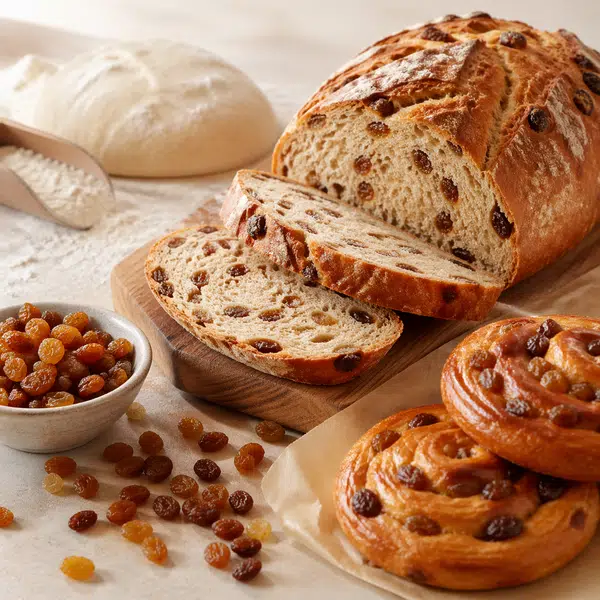
Bakery is one of the most important industrial uses for sultana raisins, but successful bakery use depends on process behavior as much as on basic fruit quality.
Turkish sultana raisins are a long-established bakery ingredient because they offer seedless convenience, natural sweetness, recognizable fruit identity and broad usability across breads, buns, cakes, pastries, cookies and bakery snacks. Their role in bakery is not limited to flavor. They also contribute visual appeal, chew, sweetness distribution and familiar product character in both mainstream and premium baked goods. For that reason, bakery manufacturers usually need more than a general dried-fruit quotation. They need a fruit profile that is technically suited to their line, dough system and finished product target.
Industrial bakery applications place specific technical demands on raisins. The fruit needs to tolerate handling, mixing, fermentation where relevant, sheeting or depositing, baking conditions and finished product packaging without creating excessive breakage, smearing, burning risk or uneven distribution. Some bakery users prioritize whole-fruit visibility in buns and sweet breads. Others want controlled size for cookies, sliced products or inclusions in softer dough systems. A fruit that works well in one bakery format may not be the most efficient choice for another.
Commercially, bakery programs are often repeat-driven and formulation-based. Once the product is approved, the manufacturer expects the ingredient to behave predictably from shipment to shipment. Variation in moisture, size distribution, fruit integrity or defect level can affect plant efficiency, bake appearance and finished product consistency. That is why buyers usually benefit from a supply discussion built around technical fit, packaging logic and annual continuity rather than simple spot buying.
This article matters because it helps buyers connect bakery needs to the correct raisin profile. Instead of discussing sultanas only as a generic dried fruit, it shows how industrial bakery users can define the right grade, moisture behavior, packing format and commercial structure for real production use.
These are the most useful points for bakery sourcing, product development and production teams.
The right raisin should work consistently through mixing, forming and baking, not only look attractive in a static sample.
Fruit that is too sticky may complicate handling, while fruit that is too dry may reduce softness and overall sensory performance in baked goods.
More even fruit size generally helps with dough distribution, visible inclusion quality and repeatability in finished bakery products.
Bakery manufacturers usually need stable specifications and recurring supply, so forecast-based programs often perform better than spot purchasing.
Sultanas work across several bakery formats, but each application places different demands on the fruit.
These products often require good fruit integrity, attractive distribution and a soft chew that fits enriched dough systems and visible fruit expectations.
In these formats, consistent fruit size and even distribution help support slice appearance, cutting performance and consumer perception.
Sultanas can add sweetness and moist chew, but the fruit needs to perform well in batters and should remain commercially suitable after baking.
These applications often require control over fruit size and moisture so the raisins do not disrupt dough handling or finished product uniformity.
Some pastry formats use raisins as visible fruit pieces or as part of mixed fillings, making fruit integrity and moisture behavior commercially relevant.
Where baked snack formats overlap with cereal or soft fruit systems, sultanas can contribute sweetness, chew and natural fruit identity.
Industrial bakery buyers usually evaluate raisins through plant behavior, dough compatibility and finished product appearance.
Size consistency helps maintain visual balance, more even dough distribution and better repeatability in product appearance from batch to batch.
Bakery users typically want fruit that is soft enough for the final eating experience but not so tacky that it complicates handling or mixing.
A higher share of intact raisins usually supports better visible inclusion quality, especially in buns, loaves and premium baked products.
Bakery manufacturers generally require strong cleaning and controlled defect levels because downstream removal is inefficient once the fruit enters production.
The fruit should contribute familiar sweetness and raisin character without off-notes that interfere with the bakery formula.
Because bakery lines are standardized, variation in fruit behavior between shipments can create avoidable process adjustments or finished product inconsistency.
These are the main points that determine whether a raisin works efficiently inside industrial bakery processes.
Moisture influences softness, stickiness, mixing behavior, bake stability and the final sensory experience of the baked good.
A narrower size range often helps with more even distribution in dough and more predictable visible inclusion levels in the final product.
Surface character affects how easily the fruit can be handled, dosed and incorporated into dough or batter without excessive clumping.
The fruit should tolerate mechanical handling as well as practical bakery conditions without unnecessary breakage or smear.
Depending on the product format, the raisins should remain commercially acceptable after baking and should not create avoidable burnt or overly dry visual effects.
The fruit should support the finished bakery product through normal storage without creating preventable texture or appearance issues.
Sweet breads, buns and enriched doughs are among the most important uses for sultanas in industrial bakery.
Their soft chew, familiar sweetness and seedless format make them highly suitable for dough-based products where fruit visibility and eating quality matter.
Uniform dispersion helps improve both product appearance and consumer experience, especially where fruit content is part of the value proposition.
Whole or largely intact fruit is generally preferred in buns, loaves and higher-value bakery products with visible fruit positioning.
Fruit that remains pleasantly soft after baking can help improve the overall perception of freshness and quality in the finished product.
Industrial bakeries benefit from a fruit profile that behaves similarly across batches, reducing process adjustments during repeated production.
Bulk industrial packs should make receiving, storage and production use efficient without unnecessary repacking or product handling loss.
These systems often require slightly different fruit behavior from dough-based bakery lines.
In cakes, muffins and cookies, more even fruit size often supports cleaner deposition, more balanced appearance and better portion consistency.
Fruit that is overly tacky may clump during batching or create uneven distribution in softer systems.
Finished bakery products often need raisins to remain commercially attractive and recognizable after exposure to bake conditions.
Sultanas should support sweetness and fruit identity without distorting the intended flavor balance of cakes, cookies or muffins.
Some batter systems can use a more practical industrial grade, while more premium bakery products may need tighter selection or stronger visual consistency.
The right fruit profile depends on the real recipe system, not only on the fruit sample considered in isolation.
Bakery users usually buy raisins in bulk, so the packing system must support product protection, warehouse efficiency and plant use.
Raisins are commonly supplied in lined bulk cartons or similar industrial formats suited to warehouse storage, transport and production handling.
Good liners help protect the fruit during transport and help maintain a usable condition when the product reaches the bakery plant.
Outer cases should tolerate palletization and long export routes without unnecessary collapse or deformation.
Bakery buyers benefit when pallet patterns, case counts and stack stability support efficient unloading, storage and internal movement.
Clear lot coding and consistent case identification support receiving, release and internal quality control systems.
Because bakery production is often continuous, supply rhythm and stock planning should be discussed as part of a broader program, not only shipment by shipment.
A stronger bakery brief usually leads to a better technical fit and a more useful quotation.
State whether the fruit is for bread, buns, cakes, cookies, muffins, pastries or mixed bakery use so the supplier can propose the right grade profile.
Clarify whether the main concern is dough distribution, fruit integrity, bake appearance, low stickiness, visible inclusion quality or overall line compatibility.
Define whether the program needs tighter size selection, stronger whole-fruit integrity, lower stem tolerance or a more practical industrial grade.
Organic, conventional, private label-adjacent or industrial approval requirements should be included before quotation is finalized.
Bakery programs are often repeat-driven, so annual volume and shipment rhythm help improve supply planning and commercial continuity.
Case weight, liner format, pallet requirements and plant-receiving preferences should be shared early to simplify implementation.
Many avoidable problems begin when raisins are bought for bakery as if they were a generic ingredient with no process implications.
A lower-cost fruit may create higher total cost if it causes poor dough distribution, more breakage, inconsistent appearance or weaker finished product performance.
Bread, buns, cakes and cookies can all use sultanas, but they do not always require the same fruit profile.
Fruit that looks acceptable as a raw sample may perform poorly after real process exposure if bake appearance and moisture behavior are not considered.
Wide size variation can reduce product uniformity and visual balance in finished bakery goods, especially in more premium lines.
A concise industrial brief helps bakery buyers and suppliers align on the right raisin profile more quickly.
Confirm the bakery application, target grade, size preference, moisture behavior and whether whole-fruit appearance is important in the finished product.
State whether the main concern is dough compatibility, bake appearance, low stickiness, fruit integrity, visual distribution or general line behavior.
Clarify expectations around stem tolerance, foreign matter control, fruit integrity, appearance range and shipment-to-shipment consistency.
Share export carton, liner, pallet and receiving requirements so the fruit arrives in a format suited to industrial bakery use.
State whether the requirement is a trial, product development stage, annual industrial program or recurring bakery contract supply.
Include estimated annual volume, shipment rhythm, target market and certification needs so the supplier can prepare a realistic industrial offer.
Atlas approaches bakery demand as a process-specific industrial requirement, not as a generic dried fruit request.
Atlas Global Trading Co. supports bakery buyers by translating product and production needs into practical raisin specifications. For sultana raisins, this means defining whether the fruit is intended for breads, buns, cakes, cookies or other bakery systems, then aligning grade, moisture behavior, packaging, documentation and annual supply structure with that real use case. This helps reduce quotation revisions and improves the chance that the fruit will perform consistently in industrial production.
The commercial goal is clear: supply raisins that are appropriate for the dough system, bakery line and finished product expectation of the customer. When product profile, bulk packing and repeat shipment planning are aligned from the beginning, the bakery program becomes easier to manage and easier to scale.
Short answers help bakery buyers review the topic quickly before sample approval or quotation.
End use, target market, desired grade, moisture preference, processing method, required certification profile and preferred pack format should be clarified first.
Because bakery applications have specific expectations around dough tolerance, fruit size consistency, moisture balance, bake stability, distribution in the dough and finished product appearance.
In many cases yes, provided the fruit, certification profile, technical specification and production requirements are aligned with the customer requirement and the available sourcing program.
The key points are fruit size consistency, manageable moisture, dough compatibility, low stem and foreign matter tolerance, flavor stability, bake performance and reliable supply continuity.
No. The best raisin is the one that fits the actual dough system and finished product requirement. A more practical industrial grade may deliver better overall value if it performs more efficiently in the process.
Because better integrity usually supports more attractive fruit distribution, improved visible inclusion quality and more stable performance through mixing and baking.