Prunes

Prunes: Private Label and Bulk Export Considerations

A practical trade guide for importers, brand owners, distributors and industrial buyers evaluating prunes for bulk supply, foodservice repacking, branded retail and private label export programs.

Export ModelBulk and retail formats
SpecificationApplication-led supply
CoordinationLaunch and shipment planning
Prunes private label and bulk export considerations guide

Why this topic matters

Prunes may look like a single product category, but commercially they behave very differently in bulk export and private label supply.

Prunes are sold across several channels, including industrial ingredient use, foodservice, wholesale redistribution, branded retail and private label supermarket programs. These channels do not buy the same way. Bulk buyers usually focus on grade, size range, pitted or unpitted format, moisture direction, carton structure and shipment continuity. Private label buyers need all of that, but also require packaging alignment, artwork control, coding logic, label claim review, barcode setup and launch timing discipline. The commercial conversation must therefore begin with the intended route to market rather than with price alone.

In bulk export, the central question is usually how to supply the right product in the most efficient export-ready format. In private label, the central question becomes how to deliver a finished consumer product that matches the retailer or brand owner’s commercial, technical and visual standards. Even when the underlying prune quality is similar, the operational model is not. That is why a supplier should distinguish clearly between bulk cartons for further repacking or industrial use and retail-ready consumer units prepared under a customer-specific label program.

Prunes are especially sensitive to application fit because they can be sold as premium whole fruit, functional snack fruit, ingredient fruit for baking, pitted processing input or a wellness-oriented retail item. Large attractive fruit may be commercially stronger in branded retail, while a more function-driven buyer may prioritize consistency, process yield and pack efficiency over shelf appearance. This affects specification setting, packing cost, approval timelines and even how the product should be quoted.

Atlas treats private label and bulk export as a distinct article topic because the risks, costs and planning requirements are different. Buyers who separate these models early generally move faster, compare quotations more accurately and avoid preventable delays linked to pack format, label approval or incomplete commercial briefing.
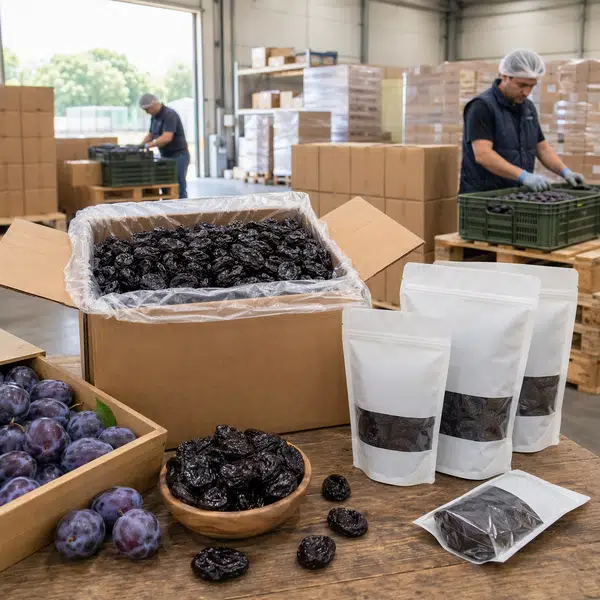
Bulk export versus private label: the practical difference

These two supply models may share the same raw material category, but they operate with different priorities and different execution complexity.

Bulk export model

Bulk programs are usually built for importers, foodservice suppliers, industrial processors or repackers. The emphasis is on product specification, shipment efficiency, packing stability, traceability and consistent repeat supply in transport-friendly formats.

Private label model

Private label programs are usually built around finished consumer presentation. They require product fit, pack architecture, artwork approval, coding standards, retail shelf logic, buyer documentation and stronger launch coordination.

Commercial speed

Bulk programs can often move faster because fewer packaging variables and approval layers are involved. Private label tends to move more slowly because multiple details must be finalized before production can start.

Risk profile

Bulk risk is often concentrated around specification mismatch, shipment timing and price structure. Private label risk expands to include artwork errors, barcode issues, declaration inconsistencies, packaging lead times and launch-date dependency.

For this reason, buyers should not evaluate bulk and private label quotations as if they are directly interchangeable. A private label offer carries additional operational work, approval management and packaging exposure. A bulk offer may look simpler, but it still needs a precise technical brief to ensure the fruit reaches the right downstream use without avoidable repacking or reformulation issues.

What buyers should define first

A more complete inquiry produces a more realistic and commercially useful quotation.

End use

Clarify whether the prunes are for direct retail sale, wholesale redistribution, bakery, snack mixes, foodservice use, cereal inclusion or further processing into chopped fruit, paste or fillings.

Format

Specify pitted or unpitted, bulk carton or retail-ready unit, and whether the fruit will be sold as whole fruit or processed further after arrival.

Grade and appearance

State the required size direction, visible quality expectations, tolerance priorities and whether appearance or processing functionality is more important for the intended channel.

Pack structure

Share target net weight, unit count per carton, inner bag or pouch type, carton dimensions, pallet pattern and any retailer-specific packing rules.

Market and label logic

Destination market, language requirements, barcode setup, legal wording and claim style should be known early, especially for consumer-facing packs.

Program scale

State whether the inquiry is for a trial, seasonal order, recurring import program, annual contract or full private label launch with multiple SKUs.

Bulk export considerations

Bulk supply may be operationally simpler than private label, but it still requires strong specification control and realistic shipment planning.

Specification accuracy

Bulk export works best when product description, pitted status, size preference, moisture direction, defect tolerance and carton format are aligned before the first commercial offer is finalized.

Transport efficiency

Carton selection, pallet pattern, load stability and warehouse handling logic all influence export efficiency, freight economics and condition on arrival.

Application fit

Industrial users may prioritize processing consistency over premium appearance, while importers serving redistribution markets may require more balanced visual and commercial positioning.

Repacking compatibility

Many bulk buyers plan to repack locally, so the fruit should arrive in a condition and carton format that supports efficient downstream handling without unnecessary waste or damage.

Shipment rhythm

Some bulk programs work on spot containers, while others require monthly or quarterly replenishment. Continuity matters more than first-shipment price in many long-term accounts.

Cost transparency

Buyers usually benefit from understanding how product grade, pitted processing, carton choice, documentation and dispatch timing influence the delivered offer.

Private label considerations

Private label supply requires more than good fruit. It requires a coordinated execution model from product specification to market-ready packaging.

Packaging development

Consumer pack weight, pouch or tray style, sealing structure, carton build, retail shelf logic and transport performance should all be defined before launch timing is committed.

Artwork and declaration review

Private label projects usually require control over artwork files, legal wording, ingredient naming, origin statements, nutrition presentation, barcode logic and batch coding format.

Approval checkpoints

Many retailers or brand owners require pack mockups, specification approval, code confirmation, sample sign-off or pre-production review before commercial packing begins.

Lead-time discipline

Private label lead time is influenced by packaging materials, print approvals, buyer response speed, production queue and shipment booking, not only by prune stock availability.

SKU management

Programs with multiple weights, languages or market versions require tighter forecasting because each SKU may have its own carton ratio, material consumption and dispatch sequencing.

Launch-date risk

Retail launches and promotional windows can be sensitive to even small operational delays. The private label plan must therefore be built backward from shelf date, not forward from product availability alone.

One of the most common private label mistakes is treating the project like a standard bulk order with a custom logo added later. In reality, private label is a coordinated packaging and compliance project built around a prune specification. It usually needs more time, earlier decision-making and clearer customer ownership over approvals.

Technical points that affect both models

Whether the program is bulk or private label, technical alignment remains central to a successful supply relationship.

Pitted or unpitted status

This changes processing route, intended usage, consumer convenience profile and commercial pricing logic. It should never be left ambiguous.

Size range

Larger, visually stronger fruit may be better suited to premium retail, while more standard commercial sizes may be fully acceptable for bulk industrial or repacking use.

Moisture and texture

Prunes must be appropriate for handling, shelf performance and downstream application. Bakery, ingredient and retail snack channels can require different texture expectations.

Visual consistency

Retail packs typically need stronger consistency in appearance, while bulk industrial programs may focus more on functionality and manageable tolerance structure.

Packaging suitability

Bag type, carton strength, retail unit stability and pallet integrity all influence both transit security and customer acceptance on arrival.

Traceability and coding

Lot identification should connect finished goods, production records, export documents and pallet labels in a way that supports clean product release and supply continuity.

Packaging strategy by supply model

Packaging is often the main dividing line between a straightforward export order and a more complex market-ready program.

Bulk cartons

Used when the buyer will repack, distribute in wholesale format or process the product further. The focus is on protection, stackability, efficient transport and functional product presentation.

Foodservice packs

Often sit between industrial and retail logic. These usually need practical portion sizes, durable outer cases and straightforward but accurate labeling.

Retail consumer units

Require greater attention to pack size, shelf appearance, opening format, print quality, coding clarity and consumer-facing declarations.

Multi-SKU private label structures

Need coordinated control of component sourcing, artwork versions, language variants, pack-out planning and carton allocation to avoid line inefficiency or packaging imbalance.

Commercial planning and quotation structure

Buyers usually get better quotations when they separate the commercial logic of fruit supply from the commercial logic of packaging and execution.

For bulk export, a quotation generally needs clear alignment on product specification, pack weight, palletization, shipment terms and order volume. For private label, the quote typically has to reflect not only the prune content and pack material, but also packaging complexity, order scale, label versioning, possible setup inefficiencies and the commercial reality of smaller or more fragmented SKU runs. Buyers often compare numbers more accurately when they understand that packaging and execution can carry a meaningful share of the final cost in finished retail packs.

Recurring programs usually outperform purely transactional spot buying because they improve packaging planning, reduce repeated setup work, support better stock allocation and create more stable dispatch scheduling. This is particularly relevant in private label, where administrative consistency can be as important as raw product cost. Even in bulk export, regular forecasts often help avoid last-minute compromises on count range, pitted availability or packing format.

What strengthens a quote

Defined grade, clear pack format, annual volume visibility, destination market details, realistic lead times and a known approval process all improve quotation quality.

What weakens a quote

Unclear labeling requirements, missing SKU data, uncertain order rhythm, vague quality expectations and no defined launch window usually create wider assumptions and slower commercial alignment.

Operational checkpoints before shipment

Strong export programs usually pass through a sequence of small but important control points before the goods are released.

1. Product confirmation

Finalize grade, size direction, pitted status, pack weight and intended channel before materials or production schedules are locked.

2. Packaging confirmation

Approve pack structure, carton build, barcode logic, coding placement and artwork files where applicable.

3. Commercial confirmation

Align the program on quantity, shipment terms, dispatch timing, pallet logic and documentation flow.

4. Production planning

Coordinate fruit allocation, pitting route if needed, packaging materials and production sequencing.

5. Pre-shipment review

Where required, check samples, pack proofs, coding details, quality release points or customer sign-off before dispatch.

6. Export release

Confirm that product, packaging and documentation remain consistent so that shipment can move without avoidable corrections or delays.

Common mistakes buyers should avoid

Most private label and bulk problems start with incomplete briefing rather than with the fruit itself.

Using one inquiry for two different models

A bulk request and a private label request should not be treated as the same commercial brief. They need separate assumptions and often separate timelines.

Requesting consumer pricing before pack details exist

Retail-ready quotations without net weight, material choice, label version and carton structure are usually provisional at best.

Underestimating approval time

Artwork, declarations, barcode checks and sample approvals can all extend the real lead time even when the prune stock itself is available.

Over-focusing on first price

The lowest headline offer is not always the most commercially reliable if pack execution, shipment continuity or technical fit are weaker.

Ignoring downstream handling

Bulk packs should match local repacking or industrial handling logic. Retail packs should match shelf and warehouse reality in the destination market.

Leaving annual volume undefined

Even an estimated volume range helps suppliers plan stock, materials and line time more efficiently, especially in multi-shipment or multi-SKU programs.

Key takeaways

These points make the article immediately useful for importers, distributors, industrial users and retail program managers.

Bulk and private label are not the same project

They use different execution models, planning timelines and cost structures even when the underlying prune grade is similar.

Packaging is a commercial driver

In private label especially, packaging decisions influence timing, cost, shelf presentation and operational risk as much as the product itself.

Specification still comes first

Product format, pitted status, size range and application fit must be locked before any reliable comparison between offers can be made.

Programs work better than reactive buying

Forecast-based supply usually improves stock continuity, line planning and quotation accuracy in both bulk export and private label projects.

Commercial discussion checklist

A short checklist helps buyers and suppliers move faster toward a practical and executable quotation.

Product brief

Confirm pitted or unpitted status, grade, visible quality expectations, intended use and whether the fruit will be sold as-is or processed further.

Packaging brief

Share carton, bag, pouch, tray, retail unit, pallet pattern, coding logic and labeling expectations as early as possible.

Program brief

State whether the inquiry is for a trial, recurring order, annual supply program, importer pack line or private label launch.

Market brief

Identify the destination country, sales channel, language requirements and whether the product is for retail, wholesale or industrial use.

Volume brief

Provide estimated yearly demand, initial order size, shipment rhythm and SKU count if more than one finished pack is planned.

Approval brief

Clarify whether samples, artwork sign-off, barcode approval, pack proofs or customer declarations are needed before dispatch.

Mini FAQ

Short answers for buyers reviewing the difference between bulk prune exports and private label execution.

What should buyers clarify first for prunes?

Buyers should clarify end use, target market, pitted or unpitted format, grade, pack style, expected order volume and whether the project is bulk supply, branded retail or private label.

Why create a separate article for private label and bulk export considerations?

Because private label and bulk export programs involve different specification logic, packaging structures, documentation flows, approval timelines and commercial risks.

Can this topic support both organic and conventional programs?

In many cases yes, provided the product profile, certification expectations, packaging materials and commercial terms are aligned with the intended market and supply model.

What usually makes private label slower than bulk export?

Private label programs usually require more coordination on packaging, artwork, coding, declarations, approval checkpoints and launch timing, while bulk export is often more direct and operationally simpler.

Is bulk always easier than private label?

Operationally it is often simpler, but it still requires clear product specification, strong packing discipline, export readiness and alignment with the buyer's downstream handling needs.

Quick Contact