Whole-fruit centers and premium fruit pieces
Whole pitted prunes can be used in coated or enrobed formats, premium fruit-and-nut combinations, chocolate applications or specialty filled products where fruit identity remains visible.
A practical trade guide for confectionery manufacturers evaluating prunes as whole-fruit inclusions, filled-center ingredients, fruit paste components and moisture-bearing sweet fruit inputs for industrial production.
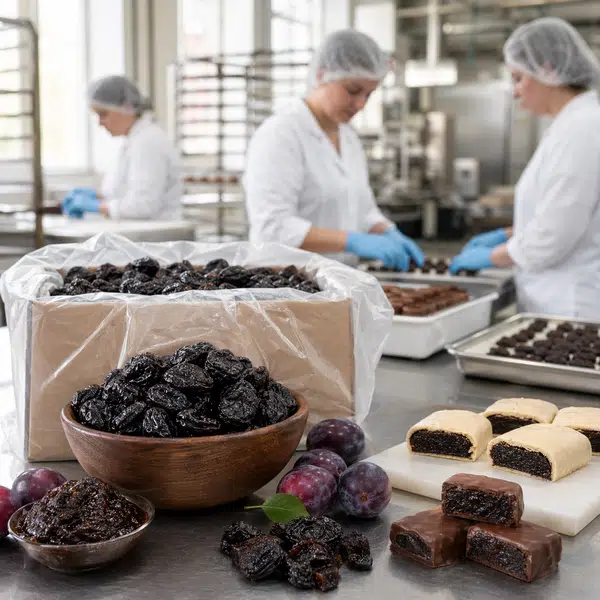
In confectionery, prunes are not purchased only as dried fruit. They are chosen for how they behave inside a formulation, on a processing line and in the finished eating experience.
Prunes can contribute sweetness, dark fruit character, chew, moisture and fruit density across several confectionery formats. Depending on the application, they may be used as whole pitted fruit, chopped pieces, fruit center material, paste base, layered filling component or texture-building ingredient inside bars and coated products. This makes them commercially interesting for confectionery manufacturers looking for a fruit ingredient that offers both sensory appeal and functional performance.
However, confectionery demand is usually more technical than standard retail demand. A confectionery buyer is often less concerned with simple shelf appearance and more concerned with process stability, cuttability, texture under line conditions, sugar balance, filling behavior, stickiness management, depositability or compatibility with coatings and compound systems. A prune that works well for a snack retail pouch may not automatically be the right prune for chocolate-coated centers, molded fillings or fruit-based chewy products.
That is why inquiries for industrial confectionery use should begin with application clarity. The right offer depends on whether the prune will remain visible as whole fruit, be chopped into inclusions, be converted into a paste-like base or serve as a moisture-bearing sweet fruit component inside a more complex formulation. The specification must support manufacturing practicality first, not only general product description.
Atlas treats confectionery use as a dedicated article topic because manufacturers benefit from a more precise discussion around format, pitted status, size direction, texture, pack style and repeatability. For ongoing production, those details matter more than generic product language and often matter as much as price.
Prunes can play multiple roles in confectionery, from visible fruit pieces to hidden structure-building ingredients.
Whole pitted prunes can be used in coated or enrobed formats, premium fruit-and-nut combinations, chocolate applications or specialty filled products where fruit identity remains visible.
Prunes may be used as cut fruit components in fruit bars, soft confectionery masses, mixed inclusions or layered products where controlled particle size and reduced processing disruption are important.
Prunes can support paste-like or puree-style fruit systems for centers, layers and chew-style products where deep fruit sweetness and a dense mouthfeel are commercially desirable.
In some product developments, prunes are used alongside other dried fruits, cocoa systems, cereals, nut pastes or seed mixes to provide sweetness, softness and dark fruit complexity.
The relevant point for industrial buyers is that each of these uses requires a different prune conversation. Whole-fruit applications may prioritize size and visual integrity, while filling or paste applications may prioritize texture response, smooth processing and predictable solids behavior. A correct brief saves time in both sampling and commercial alignment.
In confectionery, prunes are evaluated for processing behavior as much as for flavor or appearance.
For confectionery production, pitted fruit is often preferred where the prune will be enrobed, cut, ground, paste-processed or incorporated into continuous line operations. This should be specified from the start.
The fruit should match the intended operation. Some applications need a soft, pliable prune that blends or forms easily, while others require a more defined bite and better piece integrity.
Moisture balance affects cutting, mixing, depositor handling, sticking behavior, filling stability and finished product shelf performance. It is one of the most important technical discussion points.
Whole-fruit and portion-controlled applications often benefit from better size uniformity, while paste and chopped uses may allow a more flexible size direction.
Prunes contribute a distinctive dark fruit sweetness that can either support or dominate a recipe depending on use level, so product developers often assess flavor balance carefully.
Manufacturers may review how the fruit behaves during cutting, grinding, blending, pumping, depositing, layering or enrobing depending on the chosen product format.
Prunes can be commercially relevant in several confectionery sub-applications, but the technical priorities are not the same in each one.
These applications often need well-pitted fruit, good piece integrity, manageable surface behavior and enough structural consistency to move through coating or hand-finishing steps without excessive distortion.
When used in centers or filling layers, prunes must support the target eating texture while remaining process-compatible with mixing, spreading, depositing or layering operations.
Prunes can contribute body, sweetness and moisture retention in fruit-forward bars and chewable systems. In these applications, cuttability and stable texture over shelf life are important.
When combined with nuts, cocoa, cereals or seeds, prunes may act as both an inclusion and a binding-support fruit component, so particle control and tack behavior become commercially relevant.
Clear application detail improves both sampling accuracy and commercial usefulness of the offer.
State whether the prune is intended for enrobing, chopped inclusions, filling systems, fruit paste, fruit bars, layered confectionery or another specialized use.
Clarify whether the manufacturer needs whole pitted fruit, cutting-grade fruit, paste-oriented raw material or ingredient fruit for further internal processing.
Describe whether the application requires a softer fruit for blending and forming or a firmer fruit that holds shape and bite more distinctly.
Whole-piece uses often need better size alignment, while chopped or paste applications may accept broader commercial ranges if performance remains consistent.
Tell the supplier whether the requirement is for trials, product development, pilot-scale production, launch volume or repeat industrial supply.
Share the required carton size, inner liner expectations, pallet format and whether the material will go directly into production or through internal staging and storage.
The intended processing route has a major impact on the right prune specification.
Where the prune remains recognizable in the final product, buyers usually focus more heavily on pitted integrity, fruit size, visual consistency, chew profile and manageable surface behavior.
For chopped systems, manufacturers often prioritize cutting performance, stable particle formation, reduced clumping and dependable line behavior during mixing or depositing.
When prunes are used as the basis of a fruit mass, center or layered component, the discussion may focus less on whole-fruit appearance and more on blendability, consistency and texture control.
In products combining prunes with cocoa, nuts, seeds or other fruits, the fruit must support the broader formulation without causing excessive processing difficulty or product instability.
Confectionery manufacturers generally need practical industrial packs that support line efficiency, product protection and manageable warehouse handling.
Carton size should match the user's batching and warehouse logic. Oversized units can create handling inefficiency, while undersized units may increase packaging and labor cost unnecessarily.
The inner packaging should support food contact expectations, product protection and practical opening behavior for industrial use.
Stable palletization matters because confectionery buyers often run planned inbound schedules and need predictable warehouse receipt and staging performance.
Lot coding and traceability should support production control, internal QA review and repeat procurement across multiple manufacturing runs.
Industrial buyers often value simplicity in packaging: a format that preserves product condition, is easy to open, easy to stage and easy to integrate into the line. This is particularly important when prunes are one component among many in a larger confectionery production system.
In confectionery, the best prune program is usually the one that supports repeatable manufacturing performance, not simply the lowest raw material price.
Commercially, confectionery buyers usually benefit from thinking in terms of process value rather than nominal product cost alone. A prune that cuts more cleanly, blends more predictably or supports better filling consistency may create more value in production than a cheaper product that causes line disruption, formulation correction or batch inconsistency. For this reason, industrial confectionery programs are often built around functional fit, repeatability and dependable supply rather than pure spot-price comparison.
Forecast visibility also matters. If the manufacturer can share whether the requirement is for development work, seasonal production, recurring monthly use or an annual ingredient program, the supplier can respond more precisely on pack format, stock planning and continuity. Regular programs often perform better commercially than one-off purchases because material allocation and logistics can be handled with greater discipline.
Defined application, realistic technical targets, repeat volume visibility and practical industrial pack formats generally support smoother quotations and better supply continuity.
Unclear end use, vague texture expectations, trial-and-error pack selection and late changes to specification or production timing often slow the program and increase operational risk.
Most problems in confectionery sourcing begin when the prune is described too generally and the processing requirement is not defined early enough.
A prune acceptable for snack retail may still be unsuitable for cutting, blending or enrobing if industrial performance is not evaluated specifically.
This should never be assumed in confectionery applications because line safety and processing suitability depend on it.
Texture has direct impact on processability, final bite and filling behavior. General quality language is not enough.
Where the prune will be transformed into a center or fruit mass, process performance may matter more than premium whole-fruit appearance.
Industrial pack choice should reflect batching, staging and labor efficiency rather than copying a standard wholesale format.
The lower quote is not necessarily the better confectionery ingredient if it produces weaker line behavior or less reliable finished product quality.
These points make the article immediately useful for confectionery manufacturers, ingredient buyers and product development teams.
Whole-fruit, chopped, filling and paste-oriented uses require different prune specifications and should not be treated as one generic industrial request.
Softness, cuttability and handling behavior directly affect line performance and the finished confectionery result.
For most confectionery operations, pitted status should be defined at the beginning of the inquiry, not later in sampling or purchase discussions.
Trial, launch and repeat production plans usually run more smoothly when the supplier understands the intended annual or seasonal usage pattern.
A short checklist helps confectionery buyers and suppliers move faster toward a practical industrial quotation.
Confirm whether the prune is for enrobing, fruit center systems, bars, chopped inclusions, paste-style processing or another confectionery use.
State pitted status, preferred size direction, texture expectations and whether whole-fruit appearance or processing behavior is the higher priority.
Share whether the fruit will be cut, blended, ground, deposited, layered or coated so the supplier can align the offer more precisely.
Provide carton size, liner expectations, pallet format and warehouse or line-handling preferences as early as possible.
State whether the requirement is for development work, pilot production, seasonal demand, recurring industrial orders or annual supply.
Indicate expected order volume, shipment rhythm, target market and whether the program is conventional or organic.
Short answers for buyers reviewing prune suitability in confectionery manufacturing.
Buyers should clarify the confectionery application, required format such as whole, diced or paste-ready fruit, pitted status, size direction, moisture behavior and packing format before requesting a final quotation.
Because confectionery applications place specific demands on sweetness profile, texture, cuttability, inclusion stability, filling behavior, processing consistency and industrial pack suitability.
In many cases yes, provided the prune format, certification profile, specification targets and supply program are aligned with the manufacturer's processing and market requirements.
Depending on the application, manufacturers may use whole pitted fruit, cut fruit, paste-style preparations or prune ingredients intended for fillings, centers, fruit layers, coated pieces or compound formulations.
Not always. In whole-fruit coated uses it may matter more, but in paste, filling or chopped applications the priority often shifts toward processability, texture control and formulation performance.