Food safety compliance
This usually refers to process control, hygiene systems, documented handling procedures, traceability, testing support and the ability to supply product that meets agreed technical criteria.
A practical sourcing guide for importers, distributors, repackers, food manufacturers and private label teams evaluating which certifications, technical files and shipment documents are typically needed in a prune supply program.
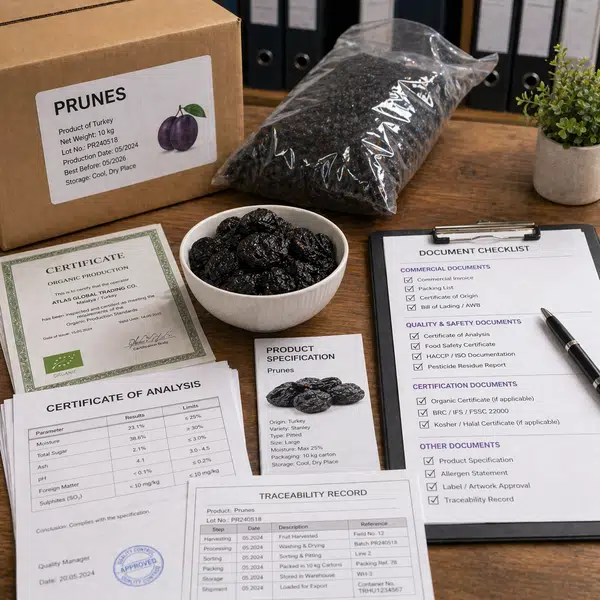
For prune programs, documentation is not only an administrative step. It is part of product approval, shipment release and customer confidence.
Prunes can move through a wide range of channels, including retail, private label, foodservice, wholesale and industrial ingredient use. In all of these channels, commercial success depends not only on fruit quality and price but also on the ability to present the right compliance package at the right time. A product can be commercially attractive on paper yet still fail to move smoothly if approvals, declarations or shipment documents are incomplete, late or not aligned with the buyer's market requirements.
Documentation requirements vary by destination, customer type and sales format. Retail and private label buyers usually require a broader technical file and stronger document discipline than a purely spot-based industrial sale. Organic programs often add another layer of certification control, chain-of-custody alignment and labeling scrutiny. Importers may also need specific declarations, shipping documents, product specifications and traceability references before customs release or internal QA approval.
For that reason, prune sourcing discussions should include compliance and documentation from the beginning, not after price agreement. Buyers should clarify which certificates are mandatory, which declarations are customer-driven, which laboratory or technical documents are needed for product approval and how shipment paperwork should be prepared. This helps avoid preventable delays, approval loops and commercial misunderstandings.
At Atlas, documentation is treated as part of total program design. Product specification, pack format, destination market, channel type and certification profile are reviewed together so the document flow supports the actual trade requirement rather than being handled as a separate issue at the end.
Compliance can refer to several layers of control, and it is important to define which layer matters for the intended sale.
This usually refers to process control, hygiene systems, documented handling procedures, traceability, testing support and the ability to supply product that meets agreed technical criteria.
Different destinations may require different labeling structures, declarations, import documents or claim limitations. The correct market profile should be defined before packing and shipping.
Many buyers have internal supplier approval rules that go beyond general market requirements. They may request questionnaires, declarations, specification templates or audit-related documents in their own format.
Some programs require formal third-party certification, while others only need standard commercial and technical documentation. The difference affects both lead time and supplier suitability.
Not every buyer needs every certificate, but most serious programs require clear alignment on certification scope.
These are often requested by organized retail, food manufacturers and private label buyers who want evidence of structured process control, documented hygiene systems and repeatable operational discipline.
Where organic prunes are involved, the program usually requires valid organic certification, document consistency across product, packing and sales flow, and correct alignment between label claims and certification scope.
Some customers may ask for information related to responsible sourcing, labor standards or supply chain policies, especially in branded retail and multinational procurement environments.
In many cases the decisive requirement is not a public certificate alone but whether the supplier can satisfy the buyer's own onboarding and documentation framework.
Programs involving organic, natural positioning, private label statements or channel-specific claims usually require closer control over supporting files and packaging language.
Depending on the market, importers may ask for documentation that supports customs handling, food control review or internal legal clearance before the goods are released for sale.
These are the documents most often needed for supplier approval, product approval and shipment release.
A product specification normally defines the prune format, pitted or unpitted status, size profile, moisture expectations, sensory description, defect tolerance, packaging format and any agreed technical parameters.
Many buyers request a lot-related certificate of analysis or equivalent technical report to support approval of key quality or safety parameters before shipment or after production.
Lot references, production coding, packing dates and shipment linkage are important for recall readiness, complaint handling and importer-side stock control.
Even simple dried fruit programs may require confirmation of product composition, processing status and pack contents in a formal declaration format.
Depending on the packing environment and customer policy, buyers may request formal allergen-control or cross-contact documentation as part of their supplier approval file.
Retail and foodservice customers often need a defined shelf-life statement and recommended storage guidance that matches both the product and the packaging system.
Where private label, foodservice or retail packs are involved, the technical file may also need primary pack, outer carton and labeling details tied to the approved commercial format.
For organic programs, buyers may require additional transaction-level paperwork or certification references to support organic status through the trading chain.
These documents support the physical export and import process, not only the technical approval stage.
In practical trade, prune shipments usually move with a set of commercial shipping documents that may include the sales invoice, packing list, transport-related paperwork, origin-related documents where relevant and other records required for customs, banking or importer receipt. The exact bundle depends on the agreed sales term, destination market, channel type and whether the shipment is standard bulk trade or a more structured private label or certified program.
Buyers should confirm document format expectations early. Small differences in consignee details, product description wording, lot references, pack descriptions, pallet counts or label language can create avoidable clearance delays or internal receiving problems. This is especially true when the importer's QA, procurement, logistics and customs functions are handled by different teams.
For repeat programs, document standardization is often highly valuable. Using a stable structure for specifications, declarations and shipment paperwork makes approvals faster, reduces back-and-forth and helps buyers compare each shipment more easily against prior lots.
These two program types may look similar commercially, but their document control needs can be very different.
Conventional trade usually focuses on core food safety documents, product specifications, technical approval records, shipping documents and any customer-specific declarations relevant to the destination or channel.
Organic programs generally require stronger alignment between product identity, process scope, packing status, transaction flow, labeling and certificate validity. Documentation discipline is especially important because claim integrity must remain consistent through the whole supply chain.
Organic labeling, logo use, reference wording and claim presentation should be reviewed together with the certification profile before final artwork approval and shipment planning.
Organic programs often need earlier document preparation because buyers may review certifications, label files and supporting paperwork before authorizing production or shipment.
The deeper the brand exposure and market sensitivity, the more documentation discipline is usually required.
These buyers typically require broader technical files, formal approval workflows, label review, packaging references, claim verification and customer-format declarations. Documentation must often be approved before production is released.
Industrial buyers may focus more on product function, process suitability, technical consistency and lot-level documentation than on consumer-facing label files, but their supplier-approval systems can still be demanding.
Spot programs may have a lighter document burden, but importers still need enough compliance support to move the goods efficiently and satisfy their internal controls.
In repeat supply relationships, standardized documentation, agreed specifications and clear renewal timing for certificates become important for continuity and audit readiness.
Traceability is one of the most commercially important parts of prune compliance, especially when shipments are split, repacked or moved through several warehouses.
A strong prune compliance program requires clear lot identification from production through packing and export. This does not only support food safety. It also helps manage shelf-life, handle customer questions, review performance lot by lot and resolve claims more efficiently if an issue arises after arrival. Importers and repackers especially benefit from robust lot control because they may divide, relabel or further process the product after receipt.
Traceability should connect finished product lots to packing records, shipment documents and customer delivery references wherever possible. When documentation is fragmented or inconsistent, even small issues can take too long to resolve. That creates cost, slows replenishment and weakens confidence between supplier and buyer.
From a commercial point of view, approval discipline is equally important. Product approval, packaging approval, label approval and shipment document approval should follow a clear sequence. The smoother this sequence is, the easier it becomes to support repeat prune business with fewer operational interruptions.
Many delays come from preventable misalignment rather than from major technical problems.
If the buyer does not define the destination rules and customer requirements early, the documentation package may be incomplete or incorrectly structured.
Asking for additional certificates, declarations or label changes close to dispatch can create production delays and document revision cycles.
Claims on the pack should always be aligned with the approved compliance profile. Any mismatch can create immediate commercial problems.
Many large buyers require their own templates, supplier questionnaires or specification systems. These must be built into the timeline, not treated as a last-minute detail.
When lot codes differ across specification sheets, labels, invoices and shipment records, approval and traceability become unnecessarily difficult.
Commercial teams, QA teams and logistics teams sometimes work on different timelines. The best results come when document ownership and review order are clear from the beginning.
Documentation needs are driven by channel structure, destination risk and buyer policy, not only by the fruit itself.
Prune compliance scope usually depends on a combination of target market, end use, labeling complexity, customer category, pack format, certification status, sales term and shipment frequency. Retail and private label programs often require the broadest documentation because they combine consumer exposure, brand risk and formal supplier onboarding. Industrial buyers may require fewer packaging files but stronger technical consistency. Organic programs usually add more certificate-sensitive control and more label review requirements.
Order structure matters as well. A one-off spot container may be handled with a leaner approval process than an annual program covering multiple SKUs and recurring shipments. However, the long-term program benefits more from document standardization, shared templates and pre-agreed compliance routines. Buyers who clarify requirements early often reduce both cost and lead-time pressure.
From a commercial standpoint, strong compliance management protects more than legal status. It supports smoother customs handling, faster customer approval, fewer shipment holds, better supplier credibility and a more stable repeat-order relationship.
These details help suppliers prepare a commercially relevant offer and the right supporting document profile.
State the destination country or region and whether the sale is for retail, private label, foodservice, wholesale or industrial use.
Clarify whether the program is conventional or organic and whether any specific food safety, ethical or customer-mandated certifications are required.
List the essential technical documents, declarations and shipment papers needed for importer approval, customs handling or customer onboarding.
Confirm whether the program is bulk, foodservice, retail or private label packed, because packaging format strongly affects documentation scope.
Explain whether supplier approval, sample approval, artwork approval and shipment approval must happen in a specific order inside the buyer organization.
Share whether the requirement is a trial shipment, a one-time container or a recurring annual program, since ongoing business benefits more from document standardization.
These points make prune compliance discussions more practical and more commercially useful.
Certification and documentation needs should be defined early, not after the price is agreed.
Retail, private label, foodservice and industrial buyers do not all require the same document depth or approval structure.
Organic programs usually need stronger alignment between certificate scope, product identity, labeling and transaction paperwork.
Clear lot control and linked records support faster issue resolution, smoother stock handling and stronger importer confidence.
Repeat programs work better when specifications, declarations and shipment paperwork follow a stable structure.
Strong compliance discipline improves approval speed, reduces avoidable holds and helps build more reliable prune supply programs.
Short answers to common buyer questions around prune certifications, compliance and documentation.
Buyers should first confirm the target market, end use, required certification profile, product specification, labeling expectations and the exact document set needed for import and customer approval.
Because documentation requirements can vary significantly by market, sales channel, product format and customer policy, and they often influence approval timing just as much as price or fruit quality.
Common documents include product specifications, certificates of analysis, food safety certificates, organic documentation where applicable, traceability records, commercial shipping documents and customer-specific declarations.
Yes. These programs often involve broader supplier approval files, label review, packaging references, customer templates and stricter document timing before production or shipment.
Because clear lot identification helps with product approval, stock control, complaint review, recall readiness and importer-side handling after arrival.
In many cases yes, provided the fruit, process controls, certification scope and document package are aligned with the customer requirement and destination market.