Importer and repacker model
Many bulk buyers are importers, repackers or distributors who receive the product in larger formats and later convert it into local retail, foodservice or industrial packs.
A practical trade and sourcing guide for buyers evaluating whether dried sour cherries should be handled as a bulk export item, a private label retail line or a structured program combining both.
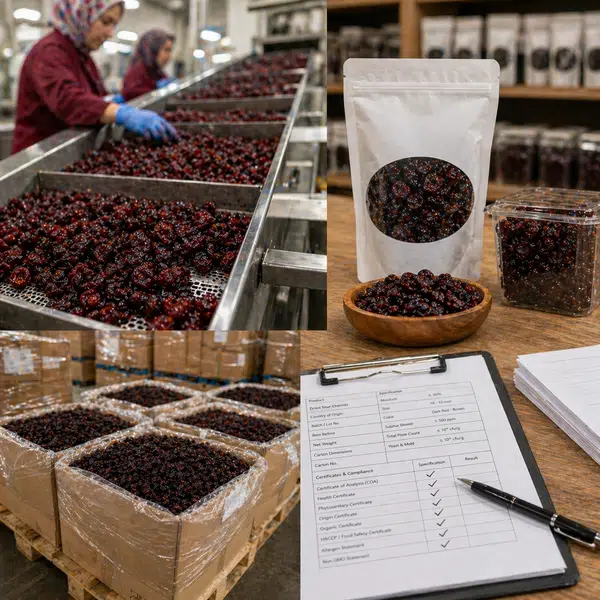
Dried sour cherries can serve very different markets, and the commercial structure changes significantly between bulk export and private label supply.
Dried sour cherries can sit in several value chains at once, from premium retail and private label snacks to bakery, cereal, confectionery, ingredient and industrial use. Their tart profile, color impact and strong flavor identity make them commercially attractive, but buyers should not assume that the same specification and pack logic will work equally well across all channels. A bulk export program and a private label retail program may start from the same fruit, yet they quickly diverge in packaging, approvals, quality emphasis and execution risk.
That is why a clearer conversation is needed than simply asking for a price per kilogram. Buyers should define end use, product format, sweetness profile if relevant, target market, acceptable appearance, labeling requirements, pack type and shipment rhythm before the right commercial structure can be proposed. Industrial buyers may care more about process suitability, cuttability, moisture control and supply continuity, while retail and private label buyers often prioritize visual presentation, shelf readiness, label compliance and launch timing.
Commercially, successful dried sour cherry programs are built around timing, specification discipline and realistic channel fit. Crop windows, pack material lead times, document approval cycles, container planning and destination expectations all affect final competitiveness. A supplier conversation becomes far more productive when the buyer states whether the target is bulk repacking, foodservice, industrial ingredient use, branded retail or private label launch.
For Atlas, this topic matters because many international buyers do not need only a product. They need the correct commercial model for that product. Bulk export and private label are not simply different pack sizes. They are different operating models, with different planning demands, risk profiles and margin logic.
Bulk export programs are designed for buyers who will handle the product further after arrival rather than sell it directly in the original export pack.
Many bulk buyers are importers, repackers or distributors who receive the product in larger formats and later convert it into local retail, foodservice or industrial packs.
Bulk supply is common when the dried sour cherries will be used in bakery, snack blends, cereals, fillings, dairy applications or other formulations where final consumer packaging happens later or not at all.
These programs usually focus on freight efficiency, stable specification, handling practicality, lot traceability, export-safe packing and dependable documentation rather than shelf-ready presentation.
Bulk export often gives the buyer more freedom to adapt labeling, local language requirements, retail format or promotional timing at destination.
Private label programs are not just packed fruit. They are finished retail or branded supply systems with tighter execution requirements.
Private label buyers require a finished consumer format that is aligned with shelf presentation, brand positioning, legal text, barcode logic and destination market expectations.
Private label projects normally involve a more formal sequence of product approval, artwork approval, packaging confirmation, compliance review and shipment release.
Because the product reaches the consumer in the original sales pack, private label programs usually require tighter visual consistency, stronger pack presentation and clearer alignment on acceptable variation lot to lot.
Retail calendars, promotions and shelf commitments can make private label programs more timing-sensitive than bulk export business, even when the underlying fruit quality is similar.
The same product category can behave very differently depending on which commercial route is chosen.
Usually emphasizes cost efficiency, process suitability, handling ease, shipping practicality and destination-side flexibility.
Usually emphasizes consumer presentation, label compliance, approved packaging, repeatable pack appearance and stricter execution timing.
Bulk programs often compete more on landed utility, while private label programs compete on finished value proposition and retail execution quality.
Private label buyers often require broader product files, label checks and customer-format approvals, while bulk programs may keep the documentation structure more operational and technical.
Bulk formats are usually simpler and faster to deploy, while private label packs may require pouches, printed materials, carton setup, language control and barcode coordination.
Private label projects usually need earlier planning because fruit, packaging and approvals must all be synchronized before dispatch.
Even though the commercial models differ, both still depend on product-fit discipline.
For dried sour cherries, the underlying product definition remains critical regardless of whether the program is bulk or private label. Buyers should still clarify whether the fruit is intended for direct snacking, bakery use, ingredient processing, cereal inclusion or premium retail. Appearance, sweetness balance where relevant, moisture style, piece integrity, visible quality and packing behavior all matter. These characteristics influence not only the consumer perception in private label formats but also the operational performance of the fruit in bulk industrial or repacking environments.
A key commercial mistake is to assume that a fruit acceptable for industrial bulk use is automatically the right candidate for a finished private label pack. The reverse can also be true: a premium private label specification may be unnecessarily costly for an ingredient buyer whose main priority is process yield and flavor impact rather than shelf appearance. The right sourcing decision therefore begins with application fit and then moves into the correct commercial model.
In practical trade discussions, Atlas encourages buyers to define product format, quality tolerance, pack style, expected annual demand and channel use together. That is how bulk and private label conversations become clearer and more commercially useful.
Bulk programs work best when packaging protects the fruit while supporting efficient handling and freight performance.
Bulk dried sour cherries are usually packed for export in food-safe formats designed to protect product integrity through warehousing, container loading and overseas shipment.
The right bulk format helps the importer unload, store, repack or process the product with minimal unnecessary labor or product stress.
Clear carton marking, lot references and traceability are especially important in bulk programs because the product may later be divided into multiple downstream channels.
Pallet build quality, carton strength and export stability matter more than visual shelf presentation in bulk business. The goal is safe arrival and efficient handling.
Importers planning local repacking should clarify whether the incoming bulk format supports their destination-side process, storage system and throughput expectations.
Bulk supply can still support premium-grade fruit. It simply means the commercial model is built around further handling after arrival rather than retail-ready export presentation.
Private label success depends on getting the fruit, pack and artwork into the same disciplined process.
Private label dried sour cherries may need a pack format suited to retail shelf display, consumer convenience, product protection and brand positioning. The pack must support both function and presentation.
Retail-ready supply usually requires pack artwork approval, language checks, barcode setup, legal text verification and alignment between label claims and product documentation.
Even in private label, secondary packaging remains important. Retail cartons, transport cases and pallet dimensions should match customer or retailer handling expectations.
Private label programs should align fruit availability, packaging materials, approved specifications and dispatch timing with the retailer's or brand owner's launch plan.
Because the product reaches the consumer in the final pack, visible quality, pack fill consistency and presentation control often carry more commercial weight than in bulk export business.
Late changes to artwork, pack size, claims or labeling logic can disrupt the entire production sequence. Private label projects benefit from earlier lock-in of key decisions.
Both models require documentation, but private label programs usually carry broader approval responsibilities.
Bulk programs generally require product specifications, shipment paperwork, traceability records, certificates and technical support aligned with importer and market requirements.
Private label programs often add artwork files, customer declarations, retail label checks, packaging references and more structured approval timing before production is released.
If the supply is organic, both bulk and private label models require disciplined certification alignment, but private label adds extra label and claim sensitivity.
Larger retail or branded customers often use their own templates and approval documents. These should be planned into the commercial timeline from the start.
The right supply model should match how the goods will actually move and be used after arrival.
Bulk export dried sour cherries usually provide more destination-side flexibility in logistics. The importer can receive larger units, repack locally, serve multiple channels and adjust timing with fewer export-side packaging constraints. This can be commercially attractive for companies with local packaging capability, diversified customer bases or evolving label requirements.
Private label supply, by contrast, often needs more precise dispatch timing because the goods are already committed to a finished retail format. Packaging delays, label issues or freight shifts can therefore have a more immediate effect on launch timing and retail execution. For that reason, private label programs usually benefit from earlier freight and production planning than equivalent bulk business.
In both models, buyers should consider container strategy, pallet build, storage conditions, customs timing and warehouse receiving capability. The best program is not always the one with the lowest nominal unit price. It is the one that aligns product, packaging, compliance and logistics into a workable landed supply structure.
The right route depends on the buyer's channel model, internal capability and commercial objective.
Usually want destination-side control, flexible repacking, operational efficiency and the ability to serve different customers from one imported stock position.
Often prefer bulk because the product goes directly into processing and retail-ready export presentation is not required.
May choose bulk or intermediate packing depending on whether they repack, redistribute or serve professional kitchens directly.
Commonly choose private label or finished retail packing because they need consumer-ready presentation with approved branding and compliant labeling.
Typically require structured finished-pack programs with fixed timelines, detailed approvals and stronger presentation discipline.
Some buyers use both models at once, importing bulk for one channel and private label finished packs for another. These cases require especially clear specification separation.
Choosing between bulk export and private label is usually a strategic sourcing decision, not only a packing choice.
The decision is usually shaped by channel strategy, annual volume, internal packaging capability, retailer requirements, certification profile, target margin structure, speed to market and freight logic. Buyers with established local repacking operations often gain flexibility from bulk import. Buyers focused on finished consumer lines, retailer compliance or direct-to-shelf execution often benefit more from private label supply.
Annual volume also matters. Bulk programs can be efficient for buyers managing several SKUs and customer types from the same inventory. Private label programs often justify themselves when the finished retail identity, packaging consistency and launch timing create more value than local packing flexibility. In both cases, the correct decision should come from the total commercial structure rather than an isolated comparison of unit price.
Another important factor is timing. Bulk programs can often move faster in simpler pack formats, while private label programs usually need earlier alignment because fruit, pack materials, artwork, specifications and shipment plans must all converge before dispatch. Buyers who understand this difference tend to build more stable dried sour cherry programs over time.
A short checklist helps buyers and sellers move faster toward the right export model.
State clearly whether the inquiry is for bulk export, private label retail supply or a mixed program serving several channels.
Confirm the fruit format, expected appearance, sweetness style if relevant, target use and whether the fruit is intended for direct sale or further processing.
Share carton, bag, pouch, retail pack, pallet and labeling expectations as early as possible because they shape the whole quotation structure.
Clarify whether the project needs sample approval, artwork approval, specification approval, retailer approval or customer-format documentation before shipment.
State whether the requirement is a trial, recurring order, annual contract, retailer launch or seasonal promotional program.
Define whether the program is conventional or organic and note any customer-specific certification, document or label requirements that apply.
These points make the page immediately useful for importers, processors, retailers and private label teams.
They may start from the same fruit, but they require different thinking on packaging, approvals, timing and channel fit.
Bulk export is often best for repackers, industrial users and distributors who want destination-side control and simpler export execution.
Finished retail programs usually require tighter planning on artwork, labels, packaging, compliance and shipment timing.
The correct model should be built around the actual product use, not around a generic dried sour cherry quotation.
Private label buyers generally need broader approval files and stricter label control than bulk industrial or repacking customers.
Buyers should choose the model that fits their channel, warehouse capability, label responsibility and margin structure rather than focus on pack format alone.
Short answers help buyers review the topic quickly and keep the page practical.
Buyers should first clarify end use, target market, product format, sweetness profile if relevant, required certification, preferred pack format and whether the program is bulk, private label or mixed.
Because bulk export and private label programs operate under different packaging, labeling, approval, documentation and commercial planning requirements even when the fruit itself is similar.
Bulk supply focuses on industrial, repacking or foodservice handling efficiency, while private label supply requires finished retail presentation, approved artwork, label compliance, pack consistency and stronger launch planning.
No. Bulk export can also be used for strong-quality fruit when the buyer wants to manage repacking or multi-channel distribution after arrival.
Because fruit availability, pack materials, artwork, legal text, barcode setup, customer approvals and freight timing all need to be aligned before dispatch.
In many cases yes, provided the fruit, packing structure, certification scope and document flow are aligned with the target buyer program.