Dried Mulberries

Dried Mulberries: Industrial Applications in Bakery

A practical industrial and trade guide for buyers using dried mulberries in bakery applications such as bars, cookies, cakes, filled products, breads, cereal bakes and premium pastry concepts.

Application FocusBakery use
Technical LensProcessing fit
Commercial ViewIndustrial sourcing
Dried Mulberries: Industrial Applications in Bakery

Why this topic matters

Bakery applications require a more technical discussion than standard dried fruit trading because ingredient behavior during mixing, baking, filling and packaging directly affects finished product performance.

Dried mulberries can serve several bakery channels at once, from premium artisanal products to structured industrial lines. Their naturally sweet profile, relatively light chew, pale-to-golden appearance and specialty-fruit positioning make them relevant for bakers looking to differentiate recipes without relying only on more common dried fruit options. In bakery, however, product suitability is not defined by appearance alone. Buyers need to assess whether the fruit is appropriate for dough systems, deposited batters, inclusions, toppings, fillings or post-bake decoration.

For this reason, a serious bakery inquiry goes beyond asking for a kilogram price. Industrial buyers usually need to define end use, cut or whole format preference, target moisture style, visible quality expectations, process step, dosage level, pack format and commercial program structure before the right quotation can be prepared. A fruit that works well in a retail snack pack may not behave the same way in a cookie dough, soft cake matrix or cereal bar line.

In bakery applications, dried mulberries are typically evaluated for size consistency, moisture balance, mixing tolerance, bake stability, sweetness contribution, visual retention after processing and the risk of excessive breakage or sticking. The practical question is not only whether the fruit tastes good, but whether it performs consistently in the chosen manufacturing environment while still supporting the desired product positioning.

Commercially, dried mulberry programs become more efficient when buyers define whether the requirement is for conventional or organic supply, whether the product will be used as a visible premium inclusion or as part of a cost-controlled ingredient system, and whether the program is trial-based, seasonal or annual. Good specification discipline usually reduces quotation delays, sampling confusion and supply mismatches.
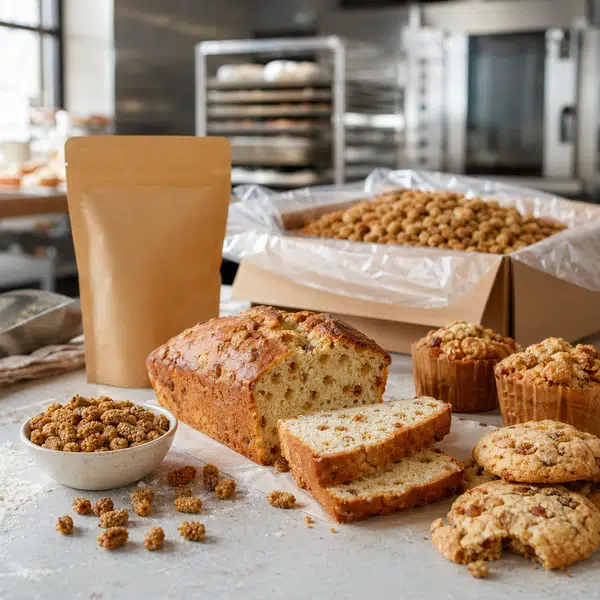
Where dried mulberries fit in bakery

The fruit can support multiple bakery concepts, but the correct grade depends on the product structure and the point of addition in the process.

Cookies and biscuit systems

Dried mulberries can be used in premium cookies, soft-bake biscuits and specialty bakery snacks where natural sweetness and visible fruit identity are important. In these formats, buyers typically focus on size consistency, manageable stickiness and how well the fruit holds shape during mixing and bake exposure.

Cakes, muffins and batter-based bakery

In cakes, muffins and loaf products, mulberries can add fruit distribution and visual differentiation. The main technical concerns are even suspension in batter, limited sink behavior, acceptable moisture migration and balanced texture in the finished crumb.

Bakery bars and baked snack bars

For cereal bars, baked snack bars and fruit-grain concepts, mulberries can function as both a flavor and visual component. Here, the fruit may need to tolerate compression, cutting and flow through inclusion systems without smearing excessively or creating unmanageable line buildup.

Breads, rolls and artisanal bakery

In premium breads and breakfast bakery, dried mulberries can support sweet specialty loaves, seeded breads and wellness-focused recipes. In these applications, the balance between dough hydration, fruit softness and even distribution becomes more important than in simple surface toppings.

Filled or layered concepts

Dried mulberries may also be considered for filled pastries, inclusions in bakery fillings or decorative finishing, depending on the formulation style. These uses require closer attention to moisture interaction and texture retention over shelf life.

Premium seasonal and private label bakery

Because mulberries offer a more distinctive fruit identity, they can support holiday bakery, gift products, organic ranges and private label concepts that need premium visual value and a cleaner product story.

Technical considerations for bakery manufacturers

The most important questions are about process tolerance, stability and consistency in finished bakery systems.

Size and grading consistency

Uniformity affects mixing distribution, portion control, visual consistency and cut performance in finished products. Highly irregular size profiles can complicate inclusion dosing and finished appearance.

Moisture and softness

Moisture level influences dough interaction, stickiness, handling ease and shelf behavior. Fruit that is too soft may smear or clump, while fruit that is too dry may become brittle and fragment during processing.

Mixing tolerance

Bakery lines often expose inclusions to mechanical stress. Buyers should consider whether the fruit needs to remain visually intact, whether some breakage is acceptable and at what stage it should be added to the process.

Bake stability

Heat exposure can affect texture, sweetness perception, appearance and surface behavior. The product should be reviewed according to whether it will be fully baked, lightly baked, added post-bake or used in a protected matrix.

Cutting and slicing behavior

In bakery bars, loaves and tray-baked products, the fruit should not create unnecessary drag, tearing or uneven cut lines. This is especially important where neat industrial slicing is required.

Flow and dosing performance

If the fruit is dosed automatically, its flowability matters. Product that bridges, compacts or sticks can disrupt consistent dosing and reduce overall line efficiency.

Moisture migration in finished products

Bakery systems are sensitive to water activity balance. Fruit inclusions should be assessed for how they influence softness, firmness and localized moisture transfer over the intended shelf life.

Microbiological conformity

Industrial bakery users usually require a microbiological profile appropriate for direct food manufacture. Expectations may vary depending on the market, the bakery process and whether the fruit is further processed or packed into ready-to-eat products.

Foreign matter and visual cleanliness

Stem presence, extraneous material and visually obvious defects are important quality points in bakery, especially where the fruit remains visible in the final product or where consumer claims risk must be minimized.

What buyers should define in a bakery specification

A useful bakery specification combines physical quality, process compatibility and commercial structure.

The first specification point is the exact bakery application. Dried mulberries intended for cookie dough, cake batter, cereal bars, bread systems or post-bake decoration may require different grade choices and different acceptance standards. Clarifying the application early helps avoid offers that look attractive on paper but do not work operationally.

The second point is the physical requirement. Buyers should indicate whether they prefer a more premium whole-fruit presentation, a controlled industrial grade with moderate size tolerance, or a softer and more process-friendly profile for batters and fillings. It is also useful to define whether some breakage is acceptable or whether the fruit must remain visually prominent in the finished product.

The third point is technical handling. If the fruit will pass through mixing, extrusion, depositing, bar-forming, slicing or baking, the supplier discussion should reflect that. Process step matters because the same fruit may behave differently in a dry blend than in a hydrated dough or syrup-bound bar system.

The fourth point is the compliance and documentation profile. Depending on the destination market, buyers may require organic certification, conventional specification, traceability support, product declarations, pesticide compliance alignment, microbiological conformity and label-related documentation. These are commercial essentials, not secondary points.

The fifth point is supply structure. The quotation becomes more useful when the buyer shares estimated order size, forecast rhythm, shipment preference, destination, pack format and whether the requirement is for testing, launch phase or annual supply continuity.

Commercial value of dried mulberries in bakery

The ingredient can support premium positioning, product differentiation and broader channel development when it is specified correctly.

Premium visual identity

Dried mulberries help bakery products stand apart from standard raisin- or cranberry-based formulations. This can strengthen shelf appeal in premium cookies, cakes and bars.

Natural sweetness contribution

The fruit supports bakery concepts looking for naturally sweet inclusions with a milder profile than sharper dried fruits. This can be useful in better-for-you and wellness-led product lines.

Organic and natural market relevance

Mulberries are especially relevant in organic bakery, natural retail and specialty channels where fruit identity and product story contribute to perceived value.

Flexible channel use

A single sourcing relationship may support ingredient supply, foodservice packs, repacking and selected private label bakery projects when grade definition and pack planning are handled clearly.

Operational and commercial risks to manage early

Most bakery sourcing problems come from vague briefs, unrealistic quality assumptions or technical details being discussed too late.

Mismatch between fruit grade and bakery process

A visually premium retail-style grade may not always be the most suitable or most economical choice for a mechanized bakery line. The selected grade should reflect the actual process and final product expectation.

Moisture-related handling issues

If the fruit is softer than the process can tolerate, sticking, smearing or line contamination may increase. If it is too dry, breakage and visual inconsistency may become a problem.

Unclear compliance scope

Organic status, market-specific documentation, declaration needs and labeling expectations should be clarified before production planning and shipment commitment.

Short-term spot buying

For recurring bakery programs, pure spot purchasing can make continuity harder to manage. Forecast-based planning usually gives better stability than reactive buying alone.

Packaging not matched to factory handling

Incorrect bulk format can reduce efficiency in receiving, storage and line feeding. Packaging should suit the actual operating environment, not just freight convenience.

Inadequate sample evaluation

Sample review should cover not only taste and appearance but also process behavior, bake result, cutting response and finished shelf presentation wherever possible.

Packing formats typically discussed for bakery programs

The correct pack format depends on whether the buyer is manufacturing, repacking or launching a private label line.

Bulk industrial cartons

These are typically the first choice for bakery manufacturers using the fruit as an ingredient. The priority is line practicality, inner liner protection, pallet stability and efficient warehouse handling.

Intermediate repacker formats

Suitable for foodservice, secondary packing or regional bakery distribution. These formats may help buyers who need more manageable handling units than full industrial bulk.

Retail and private label formats

Where the product is sold as a consumer-facing ingredient or bakery inclusion pack, visual quality, label compliance and presentation consistency become more important than basic bulk efficiency.

In all cases, buyers should confirm pack material expectations, pallet configuration, labeling needs, shipping environment and whether the product is intended for immediate use, controlled storage or direct resale. These points influence both freight practicality and delivered product condition.

Organic and conventional bakery programs

Both models can be viable, but they serve different commercial strategies and should be specified accordingly.

Organic dried mulberries are usually positioned in premium bakery, natural retail, wellness-driven snacks and specialty product lines where certification and ingredient storytelling are part of the commercial value. In these cases, buyers often need a tighter alignment between certification scope, documentation and packaging declarations.

Conventional dried mulberries may be preferred where the bakery concept is more price-sensitive, where fruit inclusion is important but an organic claim is not required, or where the buyer wants broader flexibility in industrial sourcing. The conversation here often emphasizes grade optimization, line suitability and competitive delivered cost.

Whichever route is selected, the strongest programs are generally forecast-based. Trial orders are useful for validation, but annual or seasonal planning gives better continuity for repeated bakery production, especially when product consistency and launch timing matter.

Key takeaways

These points make the article immediately useful for importers, ingredient buyers, bakery manufacturers and private label teams.

Application fit is the first decision

Dried mulberries should be quoted according to the exact bakery use, not as a generic fruit ingredient without process context.

Technical handling matters as much as appearance

Moisture, mixing tolerance, bake behavior and cutting response are central points in bakery evaluation.

Specification discipline improves quotation quality

When grade, certification, packing and demand rhythm are clear, pricing and sample review become faster and more relevant.

Forecast-based sourcing usually performs better

Recurring bakery programs generally benefit from better continuity when built around planning rather than purely spot purchasing.

Commercial discussion checklist

A short but practical checklist helps buyers and suppliers move faster toward a workable bakery quotation.

Application brief

Confirm whether the fruit is for cookies, cakes, bakery bars, breads, pastry fillings, toppings or other industrial bakery uses.

Quality brief

Share the preferred grade direction, softness level, visual expectation, acceptable breakage level and certification requirement.

Process brief

State whether the fruit is added before baking, after baking, into dough, into batter, into fillings or into bar systems.

Packing brief

Clarify carton, inner liner, pallet and label expectations, especially if the product will move directly into production.

Program brief

Indicate whether the project is a sample request, pilot run, seasonal launch, monthly demand program or annual sourcing requirement.

Logistics brief

Provide destination, preferred Incoterm, shipment rhythm and any storage or climate concerns that could influence delivered quality.

Mini FAQ

Short answers help bakery buyers review the topic quickly before moving into specification and quotation.

What should buyers clarify first for dried mulberries?

Buyers should first clarify the bakery end use, target market, grade expectation, moisture preference, certification profile, pack format and estimated annual volume.

Why create a separate article for industrial applications in bakery?

Because bakery applications have distinct technical expectations related to dough compatibility, bake stability, cutting performance, moisture balance, processing tolerance and commercial pack requirements.

Can this topic support both organic and conventional programs?

Yes. Dried mulberries can support both organic and conventional bakery programs when the fruit profile, certification scope, quality standard and packing format are aligned with the buyer requirement and destination market.

Which technical points matter most for bakery users?

The main technical points are size consistency, manageable moisture, dough compatibility, bake stability, flow during depositing or blending, microbiological conformity and packaging that protects quality during storage and transport.

Discuss your requirement with Atlas

Atlas works with importers, distributors, industrial users and private label buyers looking for structured dried fruit programs from Turkey.

If your project involves dried mulberries for cookies, cakes, bars, breads, pastries or other bakery applications, the most useful next step is to share your intended use, preferred quality direction, certification requirement, packing format and approximate volume. That helps Atlas structure the discussion around realistic grade options, supply continuity and commercial feasibility rather than a generic indication.

Whether the requirement is for initial trials, ingredient validation, recurring factory demand or private label development, a well-defined inquiry usually leads to faster sample alignment, better quotation accuracy and smoother sourcing decisions.

Request a Quote

Quick Contact