Premium visual grade
Usually preferred for retail, transparent packaging and premium natural channels. Buyers often expect more uniform appearance, better whole-fruit presentation and tighter tolerance for visible defects.
A practical sourcing and specification guide covering how buyers evaluate dried mulberry grades, size ranges and quality parameters for retail, industrial, repacking and private label programs.
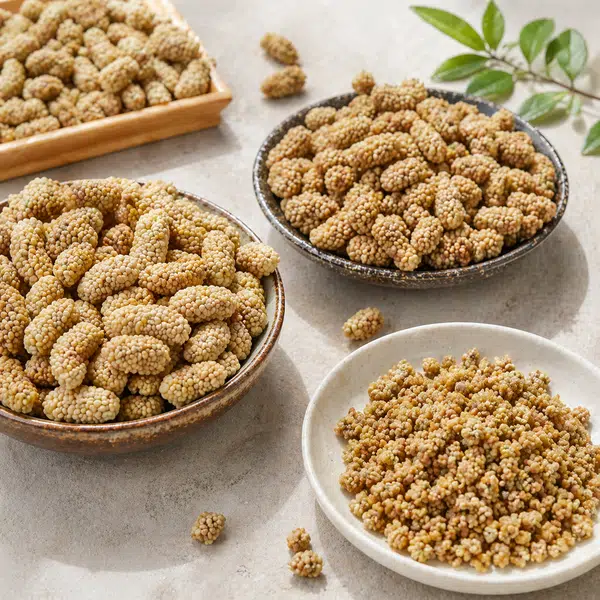
Dried mulberry trade becomes much clearer when buyers discuss specification details before they compare prices.
Dried mulberries can move through several supply channels at the same time, from premium retail and private label to industrial ingredient use and repacking. Because of that, the product cannot be evaluated properly by price per kilogram alone. The same fruit name can cover more than one commercial reality depending on size profile, visible quality, moisture style, defect tolerance, cleanliness level and pack format. Buyers who skip specification details often end up comparing non-equivalent offers.
This is why grades, sizes and quality parameters matter so much. A buyer sourcing for transparent retail packs may prioritize whole appearance, lighter color, attractive presentation and low visible defect tolerance. A buyer sourcing for industrial inclusion may still need good quality, but may place more emphasis on consistency, workable moisture, manageable breakage and reliable packing rather than premium shelf appearance. Both are valid commercial requirements, but they should not be treated as the same grade discussion.
In practice, dried mulberry grade conversations usually cover physical character, appearance, defect level, cleaning and packing suitability. Even when exact grading systems differ by supplier, the commercial logic stays the same: the clearer the quality brief, the easier it becomes to structure a workable quotation, approve samples and maintain repeatable supply.
For that reason, buyers should define the intended application, target market, required certification, pack style and the most important acceptance points before requesting firm commercial comparisons. Good specification discipline improves not only quotation quality but also continuity, sample relevance and shipment acceptance.
In dried mulberries, grade is not a single number. It is a practical combination of appearance, size, cleanliness and usability.
Usually preferred for retail, transparent packaging and premium natural channels. Buyers often expect more uniform appearance, better whole-fruit presentation and tighter tolerance for visible defects.
Suitable for many mainstream distribution and repacking programs where the product still needs to present well but does not require the highest visual standard available.
Typically evaluated more by usability than by visual perfection. Buyers often focus on consistency, manageable moisture, size practicality and cleanliness for further processing or blending.
Some programs define grade according to the specific use case, such as breakfast blends, bakery, snack mixing, repacking or private label. In these cases, the final grade language should be tied to real commercial acceptance points.
Size is one of the most important variables because it influences presentation, blending behavior, filling efficiency and perceived product value.
Dried mulberry size discussions are rarely only cosmetic. Larger, more intact fruit usually supports stronger visual presentation and premium positioning in retail packs, snack mixes and natural product lines. More mixed or commercially practical size ranges may still perform very well in repacking or industrial systems where consistent functionality matters more than a high-end visual profile.
For buyers, the key question is not whether the biggest size is always better. It is whether the chosen size profile fits the application. In transparent pouches, gift lines or premium organic shelves, a stronger whole-fruit appearance may be commercially justified. In industrial use, a slightly broader size distribution may be more efficient as long as it remains consistent and operationally workable.
Size also affects line handling. More uniform fruit can improve filling consistency, pack presentation and blending predictability. If size varies too widely, the finished product may look less balanced and dose consistency may suffer. This is why buyers should specify whether they need a tighter presentation grade or a more flexible commercial grade.
The strongest dried mulberry specifications focus on a small number of commercial and technical points that actually determine usability.
Color range influences perceived quality, especially in retail and premium natural channels. Buyers usually want a commercially acceptable and reasonably consistent appearance rather than uncontrolled variation.
The acceptable proportion of broken fruit depends on the end use. Retail and private label programs often want better whole-fruit presentation, while some industrial uses can accept broader tolerance if overall consistency is maintained.
Moisture affects texture, shelf behavior, flowability and packing condition. Fruit that is too soft may compact or stick, while fruit that is too dry may become brittle and generate excess breakage.
Stem tolerance is an important visible quality point, especially for direct-consumption channels. Clear discussion on acceptable stem presence helps prevent disputes after shipment arrival.
Visible cleanliness matters in all channels. Foreign matter control should be addressed clearly in the quality brief, especially when the product is destined for retail or further food processing.
Defects such as excessive discoloration, damaged fruit or visually unsuitable pieces should be discussed in realistic commercial terms rather than assumed loosely.
Texture is part of quality. Some buyers prefer a softer eating profile, while others need a drier and freer-flowing product for packing or mixing lines.
Depending on the market and application, buyers may require a suitable microbiological profile for direct sale, repacking or ingredient use. This should be discussed as part of supplier qualification.
Even a correct grade can lose value if the pack format does not protect the fruit well during storage and shipment. Packaging is part of the delivered quality outcome.
One of the most common buying mistakes is assuming that all channels need the same dried mulberry quality profile.
Retail buyers usually prioritize attractive appearance, tighter size consistency, stronger whole-fruit presentation, lower visible defect tolerance and a cleaner premium impression in the final pack.
Industrial buyers often still require good quality, but the focus may shift toward usable consistency, manageable moisture, process fit and commercial practicality rather than top-level display appearance.
Repackers often sit between retail and industrial requirements. They need stable incoming quality, workable carton formats, reasonable visual performance and dependable repeatability from shipment to shipment.
Private label programs usually require stronger discipline because both visual quality and documentation readiness matter. Product presentation must align with the retail promise while remaining commercially viable.
A good specification is clear enough to guide pricing and quality control, but simple enough to use consistently in real trade.
The first point is end use. Buyers should state whether the product is intended for direct retail sale, private label, repacking, ingredient use or foodservice. This immediately changes the level of visual quality and pack precision needed. The second point is grade direction. Instead of using only general words such as premium or standard, the buyer should describe what that means in practical commercial terms: whole-fruit appearance, preferred size direction, acceptable breakage, visual cleanliness and texture preference.
The third point is certification scope. Organic and conventional programs may follow similar quality logic, but they should still be separated clearly in documents, approvals and pack planning. The fourth point is pack format. Carton style, inner lining, label requirement and pallet logic all influence the condition in which the grade finally arrives. The fifth point is destination expectation. A specification for one channel or market may not be commercially sufficient for another.
Most importantly, the buyer should define the parameters that actually matter most. Overly vague specifications create misunderstanding, but overly complex specifications can also slow decision-making without adding real value. The best commercial briefs focus on the points that determine acceptability in the intended market.
Samples give the buyer and supplier a shared practical reference for how the specification should be understood.
Written specifications are essential, but dried mulberries remain a natural product with some degree of crop-related variation. That is why sample alignment is so important. A well-reviewed sample helps define what the buyer considers acceptable in terms of size profile, appearance, moisture style and general presentation. It reduces the gap between commercial wording and physical product reality.
For recurring programs, sample approval also supports continuity. Instead of restarting the same quality conversation with each order, both sides can refer back to an agreed commercial reference. This is especially helpful when the product is intended for visually sensitive channels such as retail, premium organic, private label or transparent consumer packaging.
The delivered quality is shaped not only by the fruit itself but also by how it is packed, loaded, stored and transported.
Suitable where the product is further processed or repacked. The focus is on inner protection, handling efficiency and reduced transit stress rather than retail presentation.
For direct-to-shelf programs, the pack becomes part of the quality proposition. Product appearance, fill presentation and label consistency are all more visible and commercially important.
Even a correctly graded fruit can lose value if stacking, humidity exposure or warehouse handling compromise the delivered condition before sale or use.
The same quality framework can support both program types, but the commercial emphasis may differ.
Organic dried mulberries are often used in premium retail, wellness-oriented products and natural channels where visual character, cleaner positioning and certification continuity are commercially important. In these cases, buyers may place stronger emphasis on attractive appearance, documentation readiness and consistent premium presentation across shipments.
Conventional dried mulberries may be selected for broader distribution, repacking or cost-sensitive ingredient use. Here, the commercial discussion may focus more strongly on workable grade definitions, usable size consistency and efficient supply structure. Even so, quality parameters still need to be defined clearly to avoid misalignment between expectation and delivered product.
In both program types, the best outcomes usually come when the buyer defines which parameters are critical and which are flexible. That allows the supplier to propose a realistic commercial option rather than a generic or mismatched offer.
Most misunderstandings come from unclear language, not from the product category itself.
Premium can mean different things to different buyers. It should be supported by practical expectations on size, appearance, defect tolerance and pack style.
A visually premium grade may not always be necessary for industrial use, while a practical industrial grade may disappoint in direct retail presentation.
Whole-fruit expectation versus acceptable breakage should be clarified early, especially where transparent packs or premium claims are involved.
Texture and flow behavior are part of quality. Moisture preference should be discussed before shipment planning, not after product arrival.
Packaging influences delivered condition, warehouse efficiency and final presentation. It should be treated as part of the commercial specification.
If different suppliers are quoting different effective grade levels, the prices may not be directly comparable even if the product name is the same.
A clear quality brief helps Atlas prepare a quotation that reflects the real requirement and not only a generic product assumption.
State whether the dried mulberries are for retail, private label, repacking, industrial use, foodservice or mixed-channel supply.
Describe the intended quality level in practical terms, including whole-fruit direction, size expectation, appearance standard and acceptable breakage.
Clarify the most important parameters such as moisture style, stem tolerance, visible cleanliness and general defect tolerance.
Confirm whether the requirement is organic or conventional and whether any market-specific document expectations apply.
Share carton, inner bag, pallet and labeling expectations so the delivered grade can be protected properly.
State whether the inquiry is for sample review, trial shipment, recurring order, annual program or private label development.
These points help buyers evaluate dried mulberry quotations more accurately and reduce quality misunderstandings.
It combines appearance, size, cleanliness, breakage level, moisture style and application suitability rather than acting as a single isolated metric.
Uniform and visually stronger fruit may support premium channels, while broader size ranges may still work well in practical commercial programs.
Retail, industrial, repacker and private label programs often require different tolerances and different priorities.
When buyers define the right parameters early, commercial offers become more relevant, comparable and easier to execute.
A short checklist helps buyers and suppliers move faster toward an accurate dried mulberry specification and quotation.
Confirm whether the product is intended for direct retail sale, industrial use, private label, repacking or foodservice.
State the desired presentation level, size direction and acceptable breakage profile before price benchmarking.
Define moisture style, stem tolerance, visible cleanliness and any essential acceptance parameters.
Clarify whether the program is organic or conventional and whether additional market documentation is needed.
Share carton, bag, pallet and label expectations so the quoted supply structure reflects real logistics and handling needs.
State whether the inquiry is a one-time trial, repeat commercial order or longer annual supply discussion.
Short answers on the main quality questions help buyers review the topic quickly.
Buyers should first clarify end use, target market, desired grade direction, certification profile, pack format and the key quality parameters that matter most for the intended application.
Because dried mulberry pricing, suitability and commercial value depend heavily on specification details such as size consistency, appearance, moisture style, defect tolerance, stem presence and packing format.
Yes. Grades, sizes and quality parameters can be applied to both organic and conventional programs when the certification scope, quality expectations and commercial brief are clearly aligned.
The main points are size profile, color uniformity, moisture balance, visible cleanliness, manageable defect level, foreign matter control, stem tolerance, microbiological suitability and packaging integrity.
Atlas supports buyers who need dried mulberry programs matched to real quality, packing and market expectations.
If your project requires dried mulberries for retail, industrial use, repacking or private label, the most useful next step is to share your intended application, quality direction, certification requirement, preferred pack format and approximate volume. That allows Atlas to structure the discussion around realistic grades, workable size profiles and commercially relevant quotation options rather than a broad generic offer.
Whether your need is for sample approval, ongoing distribution, annual supply or premium retail development, a clear specification usually leads to faster alignment, better quotation quality and smoother repeat business.