Foodservice packaging
Foodservice packs are usually built for operational practicality. Buyers often focus on larger unit sizes, convenient storage, manageable opening and repeated kitchen or back-of-house use rather than shelf-ready appearance.
A practical packaging and trade guide for dried mulberries covering foodservice packs, retail-ready formats, private label requirements, material choices, labeling expectations and the commercial logic behind each packaging route.
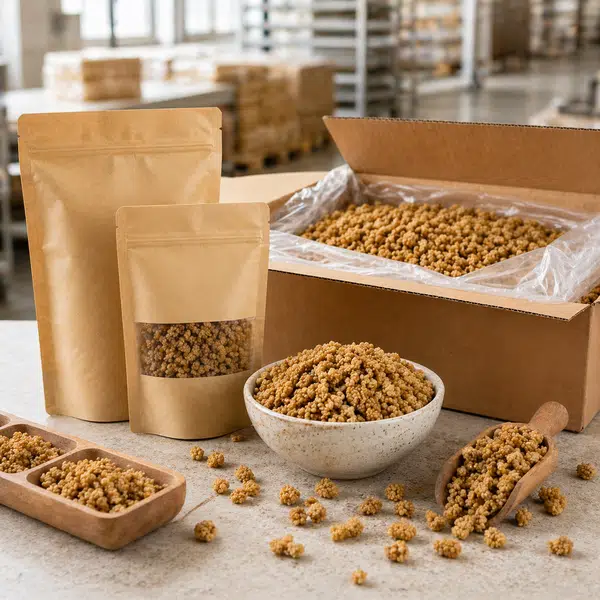
Packaging is not just a final presentation step. It directly influences shelf appeal, product protection, handling efficiency and commercial viability.
Dried mulberries can be sold through more than one channel at the same time, including direct retail, private label, foodservice, repacking and selected ingredient distribution. Because of that, packaging decisions are rarely interchangeable. A pack that works well for foodservice kitchens or distributor supply may not be suitable for retail shelves, while a retail-ready pack may add cost and complexity that are unnecessary for foodservice buyers.
For this reason, packaging discussions should begin with the channel, not with the material alone. Foodservice buyers often prioritize practical unit size, ease of handling, storage efficiency and repeatability in supply. Retail buyers, by contrast, usually place more emphasis on visual presentation, label clarity, shelf impact, portion logic and the overall consumer experience. Private label programs often require both sets of expectations at the same time.
In commercial terms, good packaging planning helps protect product quality, reduce avoidable damage, improve warehouse handling and create clearer quotation comparisons. It also shapes how the product is perceived in the market. Dried mulberries positioned as a premium natural snack in a consumer pouch require a different packaging strategy from dried mulberries supplied in larger foodservice units for hotels, bakeries, cafés or catering businesses.
That is why buyers should define pack size, intended channel, target consumer or user, visual expectation, label requirement, carton structure and shipment model before requesting final quotations. The clearer the pack brief, the more useful the resulting offer becomes.
The product may be the same, but the packaging logic is different because the end user and selling environment are different.
Foodservice packs are usually built for operational practicality. Buyers often focus on larger unit sizes, convenient storage, manageable opening and repeated kitchen or back-of-house use rather than shelf-ready appearance.
Retail packs are designed for direct sale to the consumer. Here, product visibility, portion size, brand presentation, label communication and perceived quality are usually more important than purely operational handling efficiency.
Private label programs usually combine retail presentation requirements with stricter commercial discipline on artwork, label compliance, barcode placement, carton planning and repeat consistency.
Some buyers need packaging that sits between foodservice and retail. These formats may be designed for secondary packing, regional distribution or controlled channel use where flexibility matters more than direct consumer presentation.
The right format depends on whether the buyer is selling to consumers, supplying kitchens or building a private label line.
These are commonly used when shelf impact, consumer convenience and premium presentation matter. They can support better visibility and branding, especially for health-focused, organic and natural product lines.
Suitable for simpler retail programs where cost discipline is important but a packaged consumer format is still required. These formats often depend on clear unit sizing and effective outer carton planning.
Larger bags are often preferred where dried mulberries are used repeatedly in kitchens, cafés, bakeries or buffet operations. The priority is usually ease of storage, practical handling and reduced packing cost per kilogram.
Useful for distributors, repackers and selected foodservice or industrial customers. These formats prioritize product protection, efficient transport and downstream flexibility rather than direct shelf presentation.
These require stronger attention to brand identity, print quality, mandatory label content, barcode placement, lot control and presentation consistency across repeat orders.
Some buyers use one supply base for both foodservice and retail. In such cases, packaging planning should be structured carefully so the product and documentation remain aligned across channels.
A successful dried mulberry pack should protect the product, support the sales channel and remain practical in storage, transport and handling.
Packaging becomes commercially effective when it balances product protection with market suitability. In retail, that usually means good shelf presence, readable labeling, appropriate unit size and an overall pack feel that matches the brand promise. In foodservice, it usually means pack sizes that are easy to receive, store, open and use repeatedly without excessive waste or repacking effort.
For dried mulberries, pack success is influenced by the fruit’s visual appeal and texture profile. A product sold as a premium natural snack benefits from packaging that presents the fruit cleanly and attractively. A product sold to cafés, bakeries or hotel kitchens may need less visual merchandising but more focus on durability, efficient stacking and convenient in-use handling.
Outer carton planning is also part of the packaging decision. A well-designed inner pack loses value if the outer shipping carton does not protect it properly or if pallet configuration creates avoidable transit pressure. Buyers comparing quotations should therefore look not only at the consumer-facing pack but also at the full packaging system.
The most useful packaging discussions focus on the points that directly affect product condition, handling and market fit.
The pack should provide suitable protection against external conditions so the dried mulberries maintain their intended eating quality and commercial appearance during storage and transport.
The selected unit should match how the customer buys, stores and consumes the product. Oversized retail packs or undersized foodservice units can weaken the commercial offer.
In both consumer and foodservice settings, convenience matters. Resealable formats can add value where repeat opening and controlled usage are important.
Retail packs often benefit from some level of product visibility because dried mulberries have natural visual appeal. This can strengthen consumer trust and shelf differentiation.
Pack presentation depends not only on material selection but also on filling discipline, sealing quality and overall repeatability from batch to batch.
Shipping cartons should protect the packaged units throughout export handling, warehousing and domestic distribution. Carton weakness can damage otherwise acceptable retail or foodservice packs.
Packaging should support stable stacking, loading efficiency and practical warehouse handling. Poor pallet logic can increase transit risk and reduce receiving efficiency.
Foodservice, retail and private label channels all benefit from clear batch control. Traceability is a commercial necessity, not only a technical detail.
The pack must accommodate the information required by the destination market and sales channel without crowding or reducing visual clarity.
Retail dried mulberry packs must protect the product while supporting shelf presence, brand messaging and consumer confidence.
Retail packs should present dried mulberries as a premium, clean and natural product. Shape retention, visible product quality and balanced graphics all contribute to this impression.
The chosen retail size should match the expected sales channel, consumer budget and intended use, whether snacking, breakfast inclusion or pantry use.
Organic, wellness and natural product lines often require packaging that communicates quality, simplicity and trust while still standing out on shelf.
Retail private label programs require disciplined artwork control, consistent print quality, barcode accuracy, master carton planning and repeat packaging performance across orders.
Foodservice buyers usually evaluate packaging through the lens of practicality, storage efficiency and repeated use in professional environments.
The pack should suit the usage pattern of the business. Buyers generally want a size that reduces waste, limits unnecessary repacking and fits available storage conditions.
Foodservice packs should be easy to open, store, reseal where appropriate and use during repeated service or preparation cycles.
Packaging should support receiving, rotation and stock control in kitchens, bakeries, cafés or catering operations, not just freight movement.
Foodservice programs often prioritize dependable pack logic and consistent supply over premium visual finishing. The value comes from usable, repeatable packaging rather than shelf merchandising.
For retail and branded foodservice programs, packaging must support both commercial presentation and regulatory clarity.
Labeling is part of the packaging decision from the beginning, not something to add at the end. Retail and private label programs usually require a more detailed approach to brand presentation, mandatory pack information, traceability references and layout consistency. Even when the product itself is straightforward, the label content and print execution can strongly affect the usability of the final pack.
For private label programs, buyers should align artwork expectations, pack dimensions, barcode placement, batch marking logic, language requirements and outer carton identification early. This is especially important when repeat orders are expected or when multiple sales channels are served under one branded line. A good private label program depends on packaging accuracy as much as on product quality.
Foodservice labels may be simpler than retail labels, but they still need to be clear, practical and consistent. Operators and distributors often rely on easy pack identification, reliable batch coding and straightforward storage information. The exact label structure may differ by market, but the principle is the same: clarity supports smoother handling.
Both program types can use similar packaging structures, but certification and market positioning often change the commercial emphasis.
Organic dried mulberries are commonly positioned in premium retail, specialty natural, wellness and better-for-you channels. In these programs, the packaging often carries greater responsibility for trust, clarity and premium presentation. Buyers may therefore place stronger emphasis on clean design, certification visibility, consistent labeling and packaging quality that matches the market position.
Conventional dried mulberries may be packed for broader retail, foodservice, distribution or repacking programs where cost efficiency and volume practicality are more prominent considerations. Even so, packaging still needs to be aligned with the channel and the buyer expectation. A cost-efficient pack is only commercially successful when it remains workable, consistent and market-appropriate.
Where a buyer manages both organic and conventional ranges, packaging systems should remain clearly structured so labeling, documents and stock handling stay organized. The more disciplined the separation, the easier it becomes to manage continuity and reduce commercial confusion.
Most packaging problems come from treating the pack as an afterthought instead of part of the product offer.
The correct unit size depends on who will use or buy the product. Channel logic should come first.
A cheaper pack may increase damage risk, weaken shelf presentation or reduce usability in foodservice environments.
Strong inner packs still need suitable outer protection and stable pallet logic to arrive in good condition.
Label requirements should be addressed early, especially in private label and regulated retail channels.
Retail, foodservice and repacking routes usually need different packaging logic even when the product is the same.
Programs become harder to scale when pack dimensions, artwork control or carton standards change unnecessarily between orders.
A clear pack brief helps Atlas prepare a quotation that reflects the real channel and not only a generic packing assumption.
Confirm whether the dried mulberries are for retail, foodservice, private label, repacking or mixed-channel supply.
State the preferred unit size and whether the pack is intended for direct consumer sale, distributor supply or kitchen use.
Define the required grade direction, quality level and whether the fruit should support premium shelf presentation or practical operational use.
Clarify whether the program requires plain packs, branded packs or full private label packaging with artwork and barcode integration.
Share outer carton, pallet and shipping expectations so the full packaging system can be planned correctly.
State whether the requirement is a trial run, regular supply program, annual packaging plan or private label launch.
These points help buyers choose packaging that supports both product performance and channel success.
Foodservice, retail and private label programs require different pack logic even when the dried mulberries are similar.
The right pack must protect quality during logistics while also supporting shelf appeal or operational usability.
Carton strength, pallet structure and warehouse practicality affect the delivered result just as much as the inner pack.
When buyers define pack size, label expectations and channel use early, offers become more relevant and easier to compare.
A short checklist helps buyers and suppliers move faster toward a practical dried mulberry packaging solution.
State whether the pack is for foodservice, retail, private label, repacking or a mixed sales model.
Confirm unit size, pack format, resealability expectation and whether product visibility is important.
Share whether the packaging should support premium shelf presentation or practical back-of-house usage.
Clarify branding, barcode, lot code and market-facing information expectations at the beginning.
Share carton, pallet and shipment planning requirements so the full supply structure is workable.
State whether the need is for a test run, recurring supply program, private label rollout or longer annual agreement.
Short answers help buyers review the packaging topic quickly before moving into quotation and artwork discussions.
Buyers should first clarify end use, target market, desired grade, certification profile, pack size, retail or foodservice channel and labeling expectations.
Because foodservice and retail channels require different pack sizes, presentation standards, material choices, labeling detail, outer carton planning and commercial supply models.
Yes. The same packaging framework can support both organic and conventional dried mulberry programs when certification scope, label content, material selection and market requirements are aligned.
The main packaging points are pack size, barrier protection, product visibility, resealability, filling efficiency, labeling compliance, carton strength, pallet stability and suitability for the intended sales channel.
Atlas supports buyers building dried mulberry programs for foodservice, retail, private label and repacking channels.
If your project involves dried mulberries for retail shelves, private label packs or foodservice distribution, the most useful next step is to share the target channel, pack size, quality direction, certification requirement and approximate volume. That allows Atlas to structure the conversation around workable packaging options, practical carton planning and commercially relevant quotation choices rather than a generic packing indication.
Whether your need is for a first packaging trial, a regular supply program or a full private label launch, a clear packaging brief usually leads to faster alignment, better quotation quality and smoother execution.