Same format or different format
Lerida, Garland, Protoben, diced figs and fig paste each follow different processing and market logic, so their prices should not be benchmarked as if they were interchangeable.
A practical sourcing and trade guide explaining what actually drives dried fig pricing and where commercial risk usually appears in retail, industrial, private label and bulk export programs.
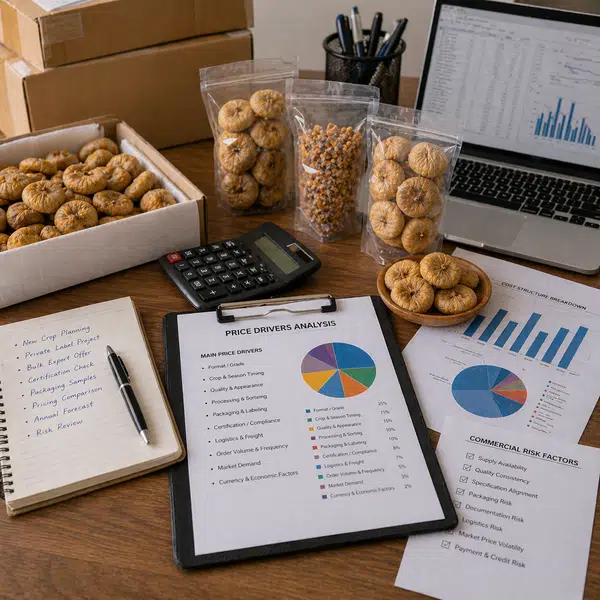
Dried fig pricing becomes much clearer when buyers understand which variables are truly changing the offer and which risks are built into the commercial structure.
Turkish dried figs are closely associated with Aydin and with a range of commercial formats such as Lerida, Garland, Protoben, diced figs and fig paste. Because these products serve different markets, channels and specifications, there is no single universal price logic. Buyers who request a quotation without defining the exact commercial route often receive offers that are difficult to compare fairly.
In practice, dried fig price formation depends on a combination of crop factors, format choice, visual quality, industrial suitability, certification profile, packaging, shipment timing and service expectations. A premium whole-fig retail program and an industrial fig paste program may both be called dried figs in conversation, but they follow different cost structures and different commercial risks. The same is true for private label retail versus bulk export.
Commercial risk also matters because the cheapest offer is not always the strongest one. A low headline price can hide risk around specification ambiguity, inconsistent packaging, weak logistics planning, unclear documentation or a mismatch between the quoted format and the buyer's intended market. Buyers therefore need to evaluate both price and exposure together.
That is why price drivers and commercial risk factors deserve their own article. The best buying decisions usually come from comparing offers against a full commercial brief rather than against price alone.
Are the offers based on the same product, the same service level and the same commercial assumptions?
Lerida, Garland, Protoben, diced figs and fig paste each follow different processing and market logic, so their prices should not be benchmarked as if they were interchangeable.
A retail-ready consumer pack, a private label line and a bulk industrial carton may all use dried figs, but their commercial cost structure is fundamentally different.
Visual quality, size consistency, presentation level and processing suitability all influence the quote. Small differences in grade definition can produce large differences in commercial value.
An offer that includes stronger packaging discipline, clearer documentation, better shipment planning or private label support may not be directly comparable with a basic bulk quote.
These are the main variables that usually move the quotation in a meaningful way.
Where the market sits within the crop cycle affects how buyers and sellers approach quotations, availability, program planning and shipment urgency.
Whole premium formats, industrial pieces and paste programs do not carry the same preparation, presentation or market value. Format choice is one of the strongest price drivers.
Retail presentation quality, size consistency and appearance expectations can raise the commercial level of the offer compared with a more practical industrial or bulk grade.
Bulk cartons, consumer packs, private label formats and stronger export packing all influence total cost, handling effort and shipment practicality.
Organic and conventional routes can follow different commercial structures, especially where certification visibility and channel-specific support are important.
Trial orders, urgent spot purchases, recurring container programs and annual planning structures often produce different quotation logic because the risk and operational burden differ.
Freight exposure, loading requirements, documentation discipline and market-specific shipment conditions can all affect the total export cost framework.
Retail, foodservice, repacking, industrial use and private label each impose different quality and service expectations that influence the offer.
A quote supported by packaging coordination, documentation readiness, annual planning or repeat-order consistency may carry a different commercial value than a basic transaction-only offer.
Format choice is one of the clearest reasons why dried fig prices vary between buyers and offers.
Lerida figs, Garland figs and other retail-facing whole formats are often evaluated with stronger emphasis on appearance, size direction, shelf presentation and consumer acceptance. That typically creates a different commercial structure from bulk industrial formats. Diced figs and fig paste are often more closely tied to processing suitability, consistency and industrial function than to premium shelf identity.
This means that two buyers may both ask for dried figs while effectively asking for very different products. One may want high-presentation retail formats for supermarket placement, while another may want process-ready material for bakery or ingredient use. The underlying fruit family may be similar, but the quotation should not be treated as the same benchmark.
For buyers, the practical lesson is simple: price becomes more meaningful when the format is defined clearly at the beginning. Without that, the risk of false comparison is high.
Packaging is not just a presentation choice. It changes the cost structure, the operational burden and the level of exporter support required.
Usually optimized for product protection, pallet efficiency, loading practicality and downstream repacking or industrial use rather than shelf display.
These add brand-facing value, but also require stronger discipline in unit sizing, print quality, label structure, outer carton planning and repeat execution.
These sit between retail and bulk, often requiring practical handling sizes and dependable logistics without the full burden of consumer branding.
Where one buyer runs both bulk and branded business, the cost structure should be evaluated separately for each route rather than blended into one average assumption.
The commercial route becomes more demanding when certification, channel-specific documentation or label-sensitive programs are involved.
Organic dried fig programs often involve a different commercial structure because certification continuity, channel positioning, packaging logic and documentation discipline may all play a larger role in the offer. Even when the physical product is similar, the program may carry additional coordination needs that influence timing and commercial value.
Conventional programs may sometimes appear simpler, but they still vary according to the channel. A conventional industrial quote and a conventional private label quote are rarely directly equivalent because the second usually includes stronger packaging and label-related obligations. Buyers should therefore evaluate certification and compliance not only as a cost point, but also as a risk management issue.
In many cases, the higher-risk commercial route is not the one with the higher nominal price. It is the one with the weaker alignment between certification needs, label structure, shipment documents and the intended market.
These are the issues that most often turn an apparently attractive quote into a difficult program later.
If format, grade, moisture direction, size expectation or pack format are not defined clearly, the buyer may think they are buying something different from what is actually quoted.
Offers can look comparable on a per-kilogram basis while being based on very different packaging, service depth or quality assumptions.
Reactive buying can increase risk because shipment timing, crop-cycle position, packing lead time and product availability may all become less flexible.
A quote designed for bulk trade may not suit private label retail, and a retail-ready offer may not be the most efficient route for industrial use.
Weak attention to carton structure, pallet logic or retail pack requirements can create avoidable costs after the order has already moved forward.
If the compliance and shipment support do not match the market route, the program can slow down even when the product itself is acceptable.
Route complexity, storage conditions, loading practices and destination handling can affect the real delivered value of the shipment.
Programs with no realistic demand visibility are harder to plan and often carry higher continuity risk than forecast-based annual structures.
Where product logic, packing method or approval standards are not stable across shipments, the commercial risk remains elevated even if the first order succeeds.
The goal is not only to negotiate lower numbers, but to create cleaner comparability and fewer costly surprises.
The strongest buyers usually reduce price risk by improving the quality of the inquiry. They define the exact format, the channel, the required packaging structure, the certification route, the annual or seasonal volume range and the timing of the shipment. This does not eliminate market movement, but it makes the quotation much more meaningful.
Another important step is separating commercial routes. Private label, bulk export, foodservice, industrial use and repacking should not be compressed into one broad request unless the buyer clearly wants alternative route pricing for comparison. Even then, each route should be quoted as a separate structure.
Finally, buyers reduce risk when they compare total commercial fit rather than unit price alone. A slightly stronger offer with better pack structure, clearer documentation or more dependable repeat execution may create lower total risk than a cheaper offer built on looser assumptions.
Annual or seasonal forecasting does not only help supply continuity. It also improves quotation accuracy and lowers commercial friction.
When buyers move from isolated spot inquiries to an annual or seasonal framework, pricing discussions usually become more realistic. The supplier can align crop timing, format planning, packaging materials, shipment rhythm and documentation around a clearer commercial structure. That generally improves comparability and reduces the hidden cost of repeated re-quotation.
This is true for both bulk and private label programs. In private label, it helps coordinate packaging and artwork timing. In bulk supply, it helps with shipment sequencing, stock flow and more stable operational execution. While not every buyer needs a formal annual contract, most recurring programs benefit from at least a forecast-based structure.
Most commercial pricing problems come from incomplete comparison logic rather than from the dried fig market itself.
Lerida, Garland, diced and paste should not be compared as if they were one single offer category.
Retail-ready, private label and bulk quotations carry different obligations and should not be treated as equal on price alone.
Undefined grade direction or presentation expectations create quotation noise and raise the chance of false comparison.
Packaging, loading, documentation and shipment execution often influence the real commercial value more than buyers expect.
Organic and conventional programs should be separated early because they may follow different channel expectations and documentation structures.
A first order may look attractive, but if the route is not stable across repeat shipments, the total commercial risk remains high.
A clear commercial brief helps Atlas build a quotation that is more comparable, more realistic and more useful.
State whether the requirement is for Lerida, Garland, Protoben, diced figs, fig paste or another defined commercial route.
Confirm whether the product is for retail, private label, foodservice, repacking, industrial use or bulk distribution.
Define the grade direction, presentation level and whether the priority is shelf appearance or downstream processing suitability.
Share carton, retail pack, industrial pack, pallet and label expectations before asking for price benchmarking.
Clarify whether the route is organic or conventional so the quotation can reflect the correct commercial framework.
Indicate whether the requirement is a trial, urgent spot shipment, recurring order or annual supply program.
These points help buyers compare dried fig offers more accurately and reduce commercial exposure.
Format, grade, packaging, certification and channel expectations all shape the quotation in ways that simple kilogram comparisons cannot capture.
The less defined the commercial route, the greater the chance that a seemingly attractive quote will create problems later.
Buyers get better pricing insight when they define format, use case, pack style and program structure before benchmarking.
Annual or seasonal program logic often improves both supply continuity and quotation discipline compared with purely reactive spot buying.
A short checklist helps buyers and suppliers move faster toward a more dependable price and risk discussion.
Confirm the exact dried fig format, quality direction and intended commercial route before comparing quotations.
State whether the offer is for bulk, private label, retail, industrial or repacking business.
Share carton, retail pack, industrial pack, pallet and labeling expectations from the start.
Clarify whether the route is organic or conventional and whether any specific channel requirements apply.
Indicate whether the discussion is for spot business, new-crop planning or recurring annual supply.
Highlight any critical delivery, packaging, documentation or approval points that could affect the true commercial value of the offer.
Short answers help buyers review pricing logic quickly before moving into quotation comparison.
Buyers should first clarify end use, target market, desired format, grade direction, certification profile, preferred pack format and shipment rhythm before comparing prices.
Because dried fig pricing is shaped by more than raw supply. It depends on format, grade, crop timing, packaging, certification, logistics, channel requirements and the level of commercial risk in the program structure.
Yes. Both organic and conventional dried fig programs can be evaluated through the same pricing framework when product format, compliance profile, packing structure and commercial route are clearly defined.
Because the offers may not be based on the same commercial reality. Format, visual quality, industrial suitability, retail readiness, packaging, shipment timing, certification and service level can all change the quotation significantly.
Atlas helps buyers structure dried fig inquiries so price comparison becomes more meaningful and commercial risk becomes easier to manage.
If your project involves dried figs for retail, private label, industrial use, repacking or bulk distribution, the most useful next step is to share the exact format, channel, certification route, packing requirement and expected shipment rhythm. That allows Atlas to structure the quotation around the real commercial route rather than a broad generic assumption.
Whether the requirement is for a one-time shipment or a recurring annual program, a clearer brief usually leads to stronger pricing logic, fewer misunderstandings and better long-term execution.