Consumer-facing presentation
Retail packs must support a clear, appealing presentation of the dried figs, especially where premium visual appearance is part of the commercial value.
A practical sourcing and trade guide for buyers comparing foodservice and retail packaging routes for dried figs, including pack formats, label priorities, shelf fit, handling efficiency and annual supply planning.
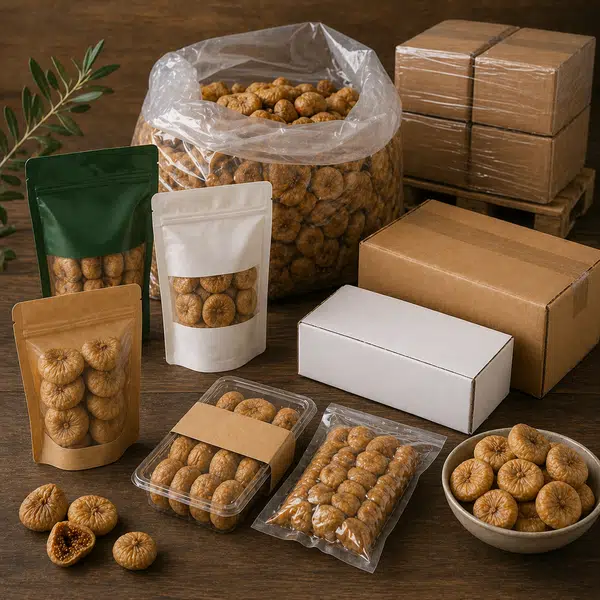
Packaging decisions change the commercial route, the cost structure and the end-user experience, so dried figs should not be packed with one generic approach for every channel.
Turkish dried figs are closely associated with Aydin and with a range of commercial formats such as Lerida, Garland, Protoben, diced figs and fig paste. Even when the same raw product is used, the packaging route can change the commercial meaning of the offer significantly. A retail pack is designed to communicate value directly to the consumer, while a foodservice pack is designed to protect the product and support efficient kitchen or professional-use handling.
This difference matters because packaging affects far more than appearance. It changes unit sizing, labeling scope, carton structure, pallet logic, handling practicality, shelf presentation and sometimes even which dried fig format is most commercially appropriate. A buyer who asks for price without clarifying pack direction may receive an offer that is technically correct but commercially incomplete.
Retail buyers often focus on consumer-facing presentation, brand alignment, shelf impact, barcode logic and repeat pack consistency. Foodservice buyers usually place more emphasis on convenient yield, resealability where relevant, durable transit protection, kitchen handling practicality and the balance between case size and operational use. These are related but distinct objectives.
This is why foodservice and retail packaging should be discussed separately. Buyers who define their packaging route early usually get more relevant quotations, better pack alignment and fewer issues during launch or recurring supply.
Retail dried fig packaging is not only about containing the product. It is part of the selling proposition.
Retail packs must support a clear, appealing presentation of the dried figs, especially where premium visual appearance is part of the commercial value.
Retail channels usually require tightly defined pack weights or consumer unit sizes so the product fits the intended price point and shelf architecture.
Retail packs usually need stronger discipline in naming, barcode placement, product claims and repeat order consistency, particularly in private label or chain-store environments.
Consumer units still need a practical case structure for warehouse handling, transit protection and retail replenishment efficiency.
Foodservice dried fig packaging is normally built around operational handling, yield and product protection rather than direct shelf display.
The pack should match the way chefs, kitchens, caterers or foodservice distributors actually use the product, rather than simply mirror retail pack logic.
Foodservice users often open, handle and store the product multiple times, so packaging should support practical ongoing use where relevant.
Case size and carton design should support professional handling, inventory control and transport efficiency without making the product difficult to work with at the operator level.
Foodservice labeling still matters, but it typically prioritizes clear product identification and practical use rather than full retail-style sales presentation.
The best pack is closely tied to the format being sold, because whole premium figs and industrial preparations do not behave the same commercially.
Often more relevant to retail or branded presentation routes where visual appearance and consumer value communication are important.
Can suit specialty retail or selected gift-style markets where the packaging should support the traditional visual identity of the product.
May work in both retail and foodservice depending on the channel, unit size and market positioning.
Usually more relevant to industrial or ingredient channels, but may also appear in selected foodservice or functional packaged applications where process-ready fruit is needed.
Typically follows an industrial or professional-use packing route rather than a mainstream consumer retail route, unless incorporated into another finished product system.
Some buyers need both retail units and foodservice or bulk packs from the same dried fig family. In these cases the packaging plan should be separated clearly by route.
The strongest dried fig packaging programs are usually decided before price benchmarking is finalized, not afterward.
The first decision is channel. Buyers should state clearly whether the dried figs are for retail, private label, foodservice, repacking or mixed-channel distribution. The second decision is unit size or practical handling format. For retail, this means the intended consumer pack architecture. For foodservice, it means the professional-use handling size that fits the kitchen or distribution model.
The third decision is the relationship between product format and packaging style. Premium whole figs may need a packaging solution that protects visual integrity and reinforces product value. A practical foodservice route may need a less presentation-focused but more operationally useful structure. The fourth decision is the label scope. Retail packs often require more detailed consumer-facing labeling and barcoding, while foodservice packs may focus more narrowly on practical product identification and trade handling.
The fifth decision is outer case and pallet logic. Even when the inner packaging is well chosen, the overall commercial result can be weakened if the case size, carton strength or pallet arrangement are not aligned with transport and distribution realities.
Private label dried fig programs usually require tighter packaging discipline because the pack is directly tied to brand identity and repeat market performance.
Private label retail programs are usually more demanding than generic retail supply because packaging becomes part of the buyer's brand system. The dried figs must not only be packed correctly, they must also appear consistent from one shipment to the next. Unit size, artwork coordination, barcode structure, label hierarchy and outer carton logic all become part of the commercial execution.
For that reason, private label buyers usually benefit from earlier packaging planning than open-market retail buyers. They often need to align product format, pack size, label structure and shipment timing before the crop cycle moves too far forward. This is one reason why strong private label programs are frequently built as annual or forecast-based structures rather than one-off spot orders.
Foodservice packs should be commercially practical at the operator level, not only efficient in export terms.
Foodservice buyers often assess how practical the product remains once opened, especially where the pack may be used over multiple service periods.
Pack size should reflect realistic kitchen or professional-use patterns so the product is commercially convenient as well as technically sound.
Large but impractical packs can create friction even if they look efficient on paper, so the packaging route should reflect the real service environment.
Foodservice packaging should also suit wholesaler, distributor or contract-supply models where case handling and storage discipline matter.
Packaging is one of the reasons two dried fig offers may differ even when the fruit origin appears similar.
Retail packaging usually adds cost through consumer unit formation, label coordination, shelf-ready presentation expectations and stronger pack consistency requirements. Foodservice packaging may appear simpler, but it still affects the quotation through case size, pack durability, operational convenience and export handling logic. Private label adds another layer because the pack must reflect the buyer's own market identity.
For this reason, buyers should compare offers on a total commercial basis rather than focusing only on the underlying fruit. The same dried figs can carry very different commercial value depending on how they are packed, labeled and delivered into the target channel.
Both can work in retail and foodservice, but the pack structure should match the channel position and compliance route.
Organic dried fig packaging often appears in premium retail, specialist natural-food channels and selected foodservice segments where certification visibility and brand credibility are commercially important. In these routes, pack clarity and documentation alignment tend to carry greater weight. Buyers usually want the packaging route to reinforce the certified product identity.
Conventional programs may have more flexibility in certain bulk, distribution and foodservice channels, but they still require clear pack planning to remain commercially practical. Whether the route is organic or conventional, the best results usually come when the pack format, product format, channel logic and shipment plan are aligned from the beginning.
Most packaging problems come from treating channel packaging as an afterthought instead of a core commercial decision.
Retail, private label and foodservice packs can create very different commercial structures, so packaging should be clarified before serious quotation comparison.
A consumer-friendly pack is not automatically the right operational solution for kitchens, distributors or professional users.
A purely practical pack may protect the product but still fail commercially if it does not support shelf presentation and consumer communication.
Retail and private label programs especially can slow down if artwork, barcode and labeling logic are not prepared early enough.
Even when the inner pack is correct, weak case planning can create problems in export handling, warehouse flow and final channel performance.
Buyers serving both retail and foodservice should usually structure these as different packaging routes, even when the base dried fig format is related.
A clear packaging brief helps Atlas prepare a more relevant commercial proposal and a more practical pack structure.
State whether the dried figs are for retail, private label, foodservice, distribution or mixed-channel business.
Confirm whether the product is Lerida, Garland, Protoben, diced figs, fig paste or another defined commercial route.
Define the intended consumer pack, foodservice pack or practical handling unit together with the expected case logic.
Clarify whether the project requires open-market labeling, private label support, barcode structure or other defined channel needs.
Confirm whether the route is organic or conventional so the pack and document framework can align correctly.
Indicate whether the project is a trial, a launch, a recurring order or a structured annual supply program.
These points help buyers choose the right dried fig packaging route and avoid unnecessary commercial friction.
Retail and foodservice packaging serve different commercial purposes, so they should not be treated as interchangeable.
The best packaging solution depends on whether the dried figs are a premium whole-fruit retail line, a practical professional-use pack or an industrial route.
Because the pack is part of the brand itself, private label packaging usually requires stronger coordination and more repeat-order discipline.
Buyers receive more useful commercial offers when pack size, label needs, case logic and channel route are defined from the start.
A short checklist helps buyers and suppliers move faster toward a practical foodservice or retail pack solution.
Confirm whether the discussion is for retail, private label, foodservice or another defined packaging route.
State the exact dried fig format before discussing final pack structure.
Share consumer unit, foodservice size, carton structure and pallet expectations as early as possible.
Clarify barcode, private label, market-facing text or other packaging communication needs from the beginning.
State whether the route is organic or conventional so the pack and compliance route align correctly.
Indicate whether the requirement is a trial, recurring order, launch or annual supply structure.
Short answers help buyers review the packaging topic quickly before moving into quotation and execution planning.
Buyers should first clarify end use, target market, desired format, grade direction, certification profile and preferred pack format.
Because foodservice and retail channels require different pack sizes, labeling logic, carton structures, handling priorities and commercial expectations.
Yes. Both organic and conventional dried fig programs can be packed successfully for foodservice and retail when the product format, certification route, label scope and channel requirements are aligned.
Retail packaging focuses on consumer presentation, shelf appeal, unit sizing and label communication, while foodservice packaging focuses more on practical handling, product protection, yield control and operational convenience.
Atlas supports buyers who want dried fig packaging aligned with the actual channel, product format and commercial objective.
If your project involves dried figs for retail, private label, foodservice or mixed-channel distribution, the most useful next step is to share the target format, intended pack size, certification route, label scope and approximate annual volume. That allows Atlas to structure the discussion around the right packaging route from the beginning.
Whether the requirement is for a first packaging trial, a foodservice rollout or a recurring retail program, a clear pack brief usually leads to better quotation quality and smoother execution.