Black Raisins

Black Raisins: Certifications, Compliance and Documentation

A practical buyer and exporter guide covering certifications, regulatory compliance, export documents, quality systems and customer approval requirements for black raisin programs.

Compliance focusFood safety and claims
Trade focusDocuments and approvals
Buyer focusRetail, foodservice, industrial
Black Raisins: Certifications, Compliance and Documentation

Why this topic matters

In black raisin trade, a competitive offer is not based only on grade and price. It also depends on whether the supplier can support the required certification profile, compliance structure and document file.

Black raisins can be supplied into premium retail, private label, foodservice, repacking and industrial ingredient channels. Each of these channels can require a different level of certification support, quality-system visibility, testing discipline and shipment documentation. For that reason, the commercial conversation should not stop at berry size, moisture style or packaging format. Buyers also need to know whether the supplier can support onboarding, technical review, labeling claims and shipment release requirements in a structured way.

From a technical standpoint, black raisins are a dried agricultural product that still requires disciplined control in raw material approval, cleaning, sorting, traceability, packing, labeling and dispatch documentation. From a commercial standpoint, the buyer needs confidence that the supplier can answer technical questionnaires, issue the right declarations, provide consistent lot information and prepare shipment files without delay. Missing, inconsistent or late paperwork can slow product approval, delay customs clearance, create receiving holds or weaken trust even when the fruit itself is commercially acceptable.

For this reason, most successful black raisin programs are built on three connected layers. The first is product definition: origin, grade, size profile, moisture style, packing format and intended use. The second is systems definition: food safety management, traceability, allergen awareness, segregation where applicable, certification scope and customer approval status. The third is shipment and support documentation: invoices, packing lists, declarations, certificates, analytical reports and any buyer-specific forms needed for technical or commercial release.

When these layers are aligned from the beginning, quotation becomes clearer, onboarding becomes faster and the chance of avoidable disputes decreases. That is why a dedicated article on certifications, compliance and documentation is commercially useful for black raisin buyers.
Why requirements differ by channel

The same black raisins may require different supporting files depending on where and how they will be sold.

Retail and private label programs

Retail buyers generally review product specification, label compatibility, origin declaration, shelf life statement, packaging format, certified food safety status and any claim-related support needed for on-pack communication. Private label programs add further scrutiny because artwork, product wording, pack declarations and shipment papers all need to align precisely.

Foodservice and distribution

Foodservice and distributor channels often require a practical but complete technical file, including product data sheets, allergen statements, storage guidance, shelf life confirmation, traceability support and reliable shipment documents. In this channel, operational clarity matters almost as much as legal compliance.

Industrial ingredient use

Industrial users usually focus on consistent specification control, process suitability, lot traceability, analytical support and a document set that fits their internal vendor approval system. They may care less about retail artwork and more about product declarations, testing logic and supply stability.

Multi-market export programs

Exporters serving more than one region must manage different declaration needs, approval forms, labeling expectations and buyer documentation standards. One standard shipment file is not always enough for every destination or customer segment.

Main certification areas buyers commonly review

The exact requirement depends on the customer, but these are the main categories that usually shape black raisin approval and export readiness.

Food safety management certification

Buyers typically want evidence that processing and packing are operated under a recognized food safety management structure with documented controls for hygiene, hazard management, traceability, inspection, corrective action and record keeping.

Organic certification

Where organic black raisins are requested, buyers usually review organic scope, validity of certification, transaction integrity, segregation between organic and conventional flow and label compatibility with the certified program.

Customer-specific vendor approval

Large retailers, foodservice groups and manufacturers may require supplier questionnaires, process flow summaries, allergen declarations, vulnerability assessments, traceability exercises and packaging information as part of onboarding.

Social and ethical expectations

Some buyers, especially large chain retailers and multinational brands, may request evidence of social compliance awareness, ethical trading principles or participation in site audit schemes as part of supplier qualification.

Claim-related documentation

If the product is marketed with specific claims, the buyer may request supporting statements for organic status, GMO-related declarations where relevant, allergen handling, non-irradiation or vegan suitability depending on the destination market.

Packaging-related compliance support

Retail and private label customers may also request packaging specifications or food-contact support documents where the market and packaging structure make this necessary.

Core compliance topics in black raisin supply

Compliance is broader than holding a certificate. It includes how the product is controlled, declared and released for shipment.

Specification control: Black raisin programs work best when the written specification is clear and approved before production. This normally includes product identity, origin, grade, size expectations, color profile, moisture style, defect tolerance, packaging format, storage conditions and shelf life basis. If the product is for industrial use, process-related expectations may also need to be defined.

Traceability: Buyers expect the lot identity to remain clear from raw material receipt or supplier-linked intake through sorting, packing, pallet labeling and shipment documentation. Strong traceability reduces approval risk and supports faster issue resolution if a question arises after dispatch.

Allergen and cross-contact awareness: Because dried fruit may be packed in multi-product environments, buyers often request allergen declarations and cross-contact control information. Even where the product itself is simple, the operational environment still matters.

Foreign matter prevention and cleaning control: Compliance discussions often include how stems, cap-stems, damaged berries and unwanted extraneous matter are minimized through sorting, cleaning, inspection and packing controls. For some buyers, this is as important as certification status.

Analytical conformity: Some black raisin programs are approved on standard routine testing, while others require shipment-specific analytical files. Typical requests may include microbiological summaries, moisture-related values, residue-related support where contracted and customer-specific release parameters.

Label and claim accuracy: For retail and private label lines, compliance includes not only the product but also the pack communication. Product name, origin statement, shelf life wording, net weight, claim language and related declarations should all remain aligned with the approved technical file.

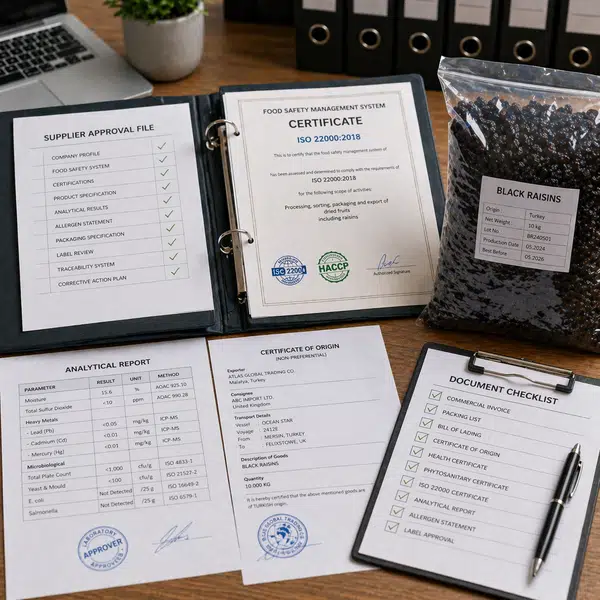
Documents commonly discussed in black raisin export programs

The exact file varies by destination and buyer, but these items are typically relevant in professional supply programs.

Commercial shipment documents

These generally include the commercial invoice, packing list, carton and pallet details, shipping marks and other transport-linked shipment papers needed for dispatch and import processing. Accuracy of product description and lot references is important.

Origin and trade papers

Depending on destination and trade structure, origin-linked papers may be requested to support customs processing or landed-cost planning. Buyers often want these requirements clarified before the order is finalized.

Technical documents

This group may include product specification sheets, product data sheets, storage guidance, allergen statements, shelf life confirmation, GMO-related declarations where requested, non-irradiation statements and other product declarations required by the buyer.

Analytical documents

Depending on the program, the buyer may request certificate of analysis, microbiological summaries, moisture-related values, inspection summaries or customer-specific release reports prepared for shipment approval.

Certification documents

These can include food safety certificate copies, organic certificate copies where relevant, site approval references and any other certification-linked materials needed for customer review.

Packaging and label support files

For retail and private label lines, buyers may require approved artwork references, packaging specifications, barcode detail, carton labeling layouts and material-related support declarations where needed.

Organic versus conventional documentation logic

Both programs can be workable, but they should not be treated as identical from a paperwork and control perspective.

Conventional black raisin programs

Conventional supply usually centers on food safety management, product specification, analytical conformity, shipment documentation and customer-specific declarations. The file can still be detailed even where organic certification is not involved.

Organic black raisin programs

Organic programs add another layer of control, including certified scope validation, segregation discipline, claim consistency, lot identity continuity and transaction-related document alignment. Buyers often review these details more closely in private label and retail organic programs.

What buyers should define before asking for a quotation

A strong inquiry produces a stronger offer. Suppliers can respond more accurately when the compliance scope is explained from the start.

Product scope

State whether the requirement is for retail, private label, foodservice, repacking or industrial use, and whether the program is conventional or organic.

Certification scope

List required food safety certificates, organic status if needed, social audit expectations and any buyer-specific onboarding forms that must be completed.

Testing scope

Clarify whether standard routine release is sufficient or whether shipment-specific analytical support is expected before dispatch.

Document scope

Indicate which declarations, certificates, technical sheets, label files or import papers are mandatory for approval and customs clearance.

Packaging and label scope

For retail and private label programs, share pack format, label language, claims profile and whether packaging material declarations or artwork approval are required.

Program scope

Clarify whether the inquiry is for a sample lot, trial shipment, repeat buying plan or annual program, because documentation effort and approval structure often scale with the program size.

Commercial implications of compliance readiness

Compliance strength affects more than legal acceptance. It directly influences speed, reliability and the total operating cost of the program.

A supplier that can present a well-structured technical and shipment file usually shortens the buyer’s onboarding and approval timeline. That improves the probability of converting an inquiry or trial into a repeat program. It also reduces the workload on the buyer’s sourcing, quality and logistics teams because fewer clarifications are needed after the order is already in motion.

For black raisins, this is especially important because many programs are recurring rather than one-off. Buyers assess not only whether the product can be shipped once, but whether the supplier can keep documentation, traceability and declaration quality consistent over repeated shipments. Strong compliance discipline therefore supports repeat business and forecast stability, not just formal approval.

It also changes price comparability. Two suppliers may quote similar product and packing, but one may include a more complete declaration set, better onboarding support, clearer traceability and stronger analytical discipline. For serious importers and brand owners, that difference can reduce hidden cost and lower commercial risk even if the unit price appears similar.

Typical risk points to review early

Many delays and misunderstandings come from missing alignment at the beginning of the discussion.

Claim profile exceeds the actual certification scope

A buyer may expect a certification or label statement that the product flow or current certificate profile does not fully support. This should be checked before artwork and commercial terms move forward.

Buyer-specific forms identified too late

If vendor questionnaires and onboarding templates are shared only after order confirmation, approval timing and shipment planning can become unnecessarily compressed.

Testing expectations not aligned

One side may assume standard internal release while the other expects shipment-specific analysis or third-party testing. This affects lead time, cost and readiness to ship.

Label review separated from technical review

Retail and private label programs work better when the label file and the technical file move together. Otherwise product wording, claims and declarations may diverge.

Organic documentation flow not fully mapped

Where organic black raisins are involved, the buyer may require more explicit document continuity across the certified shipment chain than in a conventional program.

Documents treated as an afterthought

When declarations and certificates are discussed only after the price is accepted, the program can face rework, delay and unnecessary commercial friction.

Key takeaways

These points make the article immediately useful for importers, processors, distributors and brand teams.

Certification is only part of approval readiness

Buyers should review the full system, including traceability, declarations, analytical support, labeling alignment and shipment documentation quality.

Channel determines the documentation profile

Retail, private label, foodservice and industrial black raisin programs often need different files even when the fruit itself is similar.

Organic and conventional programs should be separated clearly

Where both flows exist, document logic, claim control and operational segregation need to remain consistent with the approved program.

Documentation affects real commercial cost

Testing scope, declarations, onboarding effort and shipment file complexity can all influence lead time, operating workload and total delivered value.

Early alignment reduces shipment risk

The earlier both sides define claims, documents, testing and label expectations, the easier it is to avoid approval delays and post-order correction work.

Strong compliance supports repeat business

Reliable technical and shipment documentation helps turn first orders into stable recurring programs by reducing uncertainty for the buyer.

Commercial discussion checklist

A structured checklist helps buyers and suppliers move from inquiry to workable quotation and approval planning.

Product brief

Confirm black raisin grade, intended market, packaging format and whether the program is for retail, foodservice, industrial use or private label.

Certification brief

State required food safety, organic and customer-specific approval expectations as early as possible.

Testing brief

Clarify analytical expectations, shipment release logic and whether standard or shipment-specific documentation is required.

Documentation brief

List the declarations, certificates, product sheets and origin-linked papers that are mandatory for import and internal approval.

Label and pack brief

For private label and retail programs, share label requirements, claims profile, language needs and packaging documentation expectations.

Program brief

Indicate whether the inquiry is for a sample, a first trial, a repeat order cycle or a longer annual supply program.

Mini FAQ

Short answers on black raisin certifications, compliance and documentation.

What should buyers clarify first for black raisins?

Buyers should first clarify end use, target market, grade, certification profile, test expectations, packaging format and whether the program is for retail, foodservice, industrial use or private label.

Why create a separate article for certifications, compliance and documentation?

Because black raisins may be sold into different channels, and each channel can require different certification expectations, technical declarations, label reviews, analytical support and shipment documentation.

Which certifications are commonly discussed for black raisins?

The most commonly discussed areas are food safety management certification, organic certification where required, customer-specific approval systems and, in some cases, social or ethical audit expectations.

Can this topic support both organic and conventional programs?

In many cases yes, provided the raw material flow, segregation controls, certification scope, labeling profile and documentation file are aligned with the customer requirement and the available sourcing program.

Why is documentation discussed before price is finalized?

Because the requested declarations, testing scope, certification profile, labeling review and shipment documentation can affect lead time, packing structure, onboarding effort and total commercial cost.

Can one document pack serve every market?

No. Core shipment documents may be similar, but buyer declarations, labeling needs, technical questionnaires, testing expectations and market-specific support files can vary significantly.

Quick Contact