Chocolate-coated products
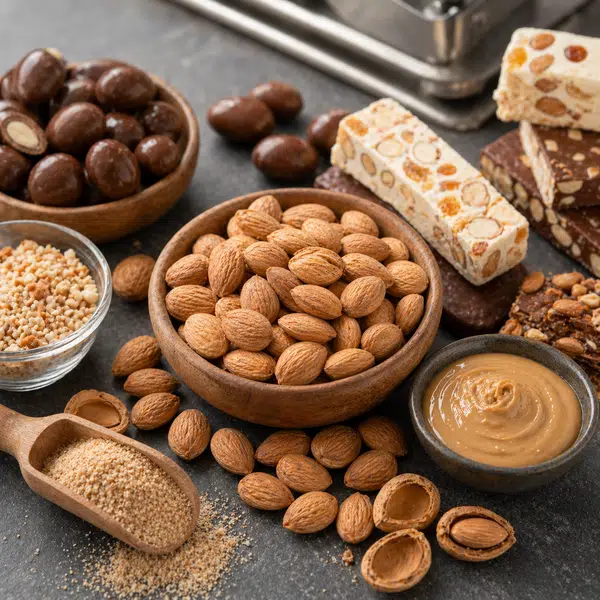
Kernels may be used as centers for coated confectionery where size consistency, whole-kernel integrity, roasting behavior and surface stability influence production efficiency and finished product appearance.
A practical buyer and exporter guide covering how apricot kernels are evaluated, processed and commercially supplied for confectionery manufacturing applications.
Confectionery buyers do not evaluate apricot kernels the same way a retail snack buyer would. In industrial use, the key issue is not only appearance but how the kernel performs inside a process and a finished recipe.
Apricot kernels can sit in several value chains at once, from niche retail and private label to ingredient and industrial manufacturing use. In confectionery, they are considered primarily as a functional ingredient. That means buyers usually need a much more precise conversation than simply asking for a price per kilogram. They need to define the kernel type, intended process, target flavor profile, physical format, acceptable appearance, pack style and production rhythm before the right commercial offer can be structured.
When discussing industrial applications in confectionery, the first question is application fit. A manufacturer using kernels for dragée centers, praline-style masses, inclusions, chocolate-coated products, nougat systems, pastes, fillings or ground ingredient blends may prioritize completely different criteria than a retail buyer. Roasting response, cutting behavior, size uniformity, defect tolerance, breakage control, flavor stability and processing consistency often matter more than purely visual appearance in a static sample.
Commercially, successful apricot kernel programs for confectionery are built around timing and specification discipline. Crop windows, kernel type, grading, packing formats, analytical expectations, container planning, food safety requirements and repeated shipment performance all affect final competitiveness. A supplier conversation becomes much smoother when buyers share annual demand estimates, intended application, processing form, pack size, target market and whether the requirement is conventional or organic.
This article helps confectionery buyers compare industrial uses, technical expectations, format options and commercial planning factors before starting a program. That makes it easier to evaluate apricot kernels as a real manufacturing ingredient rather than as a generic commodity.
Apricot kernels can fit several confectionery systems when the correct type, grade and process behavior are aligned with the formulation.
Kernels may be used as centers for coated confectionery where size consistency, whole-kernel integrity, roasting behavior and surface stability influence production efficiency and finished product appearance.
Where kernels are used in sugar or chocolate panning systems, manufacturers usually care about shape regularity, manageable breakage, kernel soundness and reasonably consistent sizing across lots.
Ground or processed apricot kernels may contribute flavor and structure in fillings, nut-style pastes, praline-type bases or confectionery creams. In these uses, grinding behavior, oil release pattern and flavor profile become commercially important.
Depending on the formulation, kernels may be included as chopped or ground ingredients where texture, flavor contribution and distribution consistency matter more than premium whole-kernel presentation.
Kernels can function as inclusions in bars, clusters or mixed confectionery products. Here the buyer often focuses on cut size control, breakage pattern, flavor compatibility and process resilience during mixing and depositing.
Some confectionery developers consider apricot kernels for specific sensory profiles or niche ingredient positioning. In these cases, flavor definition and regulatory or product-development review should be handled very carefully and explicitly.
Industrial confectionery users evaluate apricot kernels primarily as a process ingredient, so technical suitability matters as much as commercial availability.
The buyer should define whether the application requires sweet apricot kernels, bitter apricot kernels or a specific flavor-oriented concept. This is a core commercial and technical decision, not a minor detail.
Whole-kernel applications often need more consistent size, while chopped or ground applications may tolerate a broader range if the process outcome remains stable.
Excessive breakage can reduce yield, complicate panning or coating systems and create inconsistency in inclusion-style products. Buyers should define how much breakage is commercially acceptable.
Many confectionery systems depend on predictable roasting behavior. The kernel should respond consistently enough to support the intended flavor and texture outcome.
For pastes, fillings or chopped inclusions, manufacturers often focus on how the kernel behaves during size reduction, how it distributes and whether the process remains stable across repeated lots.
Industrial users usually work with a written tolerance for broken pieces, damaged kernels, visual defects or other non-conformities depending on whether the application is whole, chopped or ground.
The same apricot kernel may be suitable for one confectionery use and unsuitable for another. Specification should follow process reality.
Whole-kernel confectionery: For coated products, panned lines or visible whole-kernel inclusions, buyers usually prefer stronger size consistency, lower breakage and a more controlled visual profile. These applications are more sensitive to whole-kernel presentation and handling integrity.
Chopped inclusions: When the kernel will be chopped before use, perfect whole-kernel appearance may be less important than manageable breakage profile, cutting consistency and flavor stability. In these programs, a commercially practical industrial grade may outperform a visually premium but unnecessarily expensive selection.
Ground and paste applications: For fillings, nut-style masses or processed confectionery bases, the buyer may focus more on grinding performance, sensory result, repeatability and bulk supply continuity than on visual perfection. The correct specification should reflect the downstream formulation.
Retail-facing finished confectionery: If the final confectionery item is premium positioned, the industrial specification may still need a higher visual standard even when the ingredient is not sold separately. This is common in chocolate-coated or visible-piece applications where consumer perception matters.
Development-stage projects: In product development or limited-run launches, the buyer may initially want flexibility for trials. Once the recipe is validated, the specification should be tightened so commercial production remains repeatable.
Industrial buyers do not always want the same delivery form. The right format depends on the plant’s own capabilities and formulation design.
Suitable where the manufacturer wants to roast, coat, pan or process the kernels in-house. These programs usually require stronger discussion around size, breakage and visual quality.
Some buyers may prefer a controlled cut or split style if it improves line efficiency or ingredient distribution. In such cases, cut specification becomes part of the commercial discussion.
Where the kernels are destined for grinding, the focus shifts toward process consistency, flavor outcome and stable industrial supply rather than premium whole-kernel presentation.
For manufacturers using kernels in confectionery masses or fillings, the supplier discussion may center on whether the kernels are intended for direct further processing into pastes or similar systems.
Industrial confectionery buyers usually measure value in terms of process reliability, yield and repeated performance, not only invoice price.
A kernel that works in one test batch but behaves differently in later lots can create production inefficiency and reformulation pressure. Repeatability is therefore a major commercial value point.
Manufacturers with ongoing production usually benefit from sharing annual volume estimates and shipment rhythm. This helps structure stock planning and reduces reliance on stressful spot buying.
Industrial programs work best when the grade is defined by the actual application. Overpaying for unnecessary visual perfection can weaken cost competitiveness, while under-specifying the ingredient can create production losses.
Confectionery users often prefer export formats that protect the kernels while remaining practical for plant receipt, internal storage and batch issue. Packaging should support industrial handling, not only transport.
Many industrial issues come from incomplete product definition rather than from total absence of raw material quality.
The supplier cannot build the right proposal unless the buyer clearly states the intended type and application context from the beginning.
A visually good sample should still be tested under the real roasting, grinding, cutting or coating conditions before full commercial approval.
Some buyers request overly premium whole-kernel quality even though the product will be ground or chopped, which can raise cost without improving industrial performance.
Breakage, defect level and practical quality limits should be documented in a way that reflects the production process and not only a general export description.
A pack format that travels well but is awkward in plant storage or batch issue can create unnecessary operational inefficiency after arrival.
Manufacturers with regular demand often create avoidable risk when they rely only on last-minute coverage instead of planned supply alignment.
A better technical brief produces a better commercial offer and reduces development-stage misunderstandings.
State whether the kernels are for coating, panning, inclusions, paste, fillings, bars, praline-style systems or another confectionery use.
Confirm sweet or bitter type, organic or conventional status and whether whole, chopped or process-ready industrial use is preferred.
Explain whether roasting, grinding, chopping, enrobing, panning or blending behavior is the main functional concern.
Share acceptable limits for breakage, visual defects, size distribution and any specific appearance requirement linked to the final confectionery product.
Provide estimated volume, shipment frequency and whether the inquiry is for trial work, pilot production or a repeated annual program.
Indicate preferred export pack size, inner liner logic, pallet expectations and whether the goods will move directly into plant storage or further repacking.
These points make the article immediately useful for confectionery manufacturers, processors and sourcing teams.
Apricot kernels should be evaluated according to how they behave during roasting, cutting, grinding, coating or inclusion use, not only by visual appearance.
Whole-kernel coating applications and ground filling applications usually do not need the same commercial specification.
Sweet and bitter kernels should never be left ambiguous in a confectionery inquiry because the application logic and commercial structure may differ significantly.
Industrial approval should include real production or pilot evaluation whenever possible, not only visual inspection of a retained sample.
Regular confectionery production benefits from forecast-based sourcing, especially where consistent process behavior is important.
The ideal export pack is one that protects the kernels in transit while still fitting the customer’s receiving, storage and issue system.
A structured checklist helps buyers and suppliers move from a general confectionery inquiry to a workable industrial supply proposal.
Confirm kernel type, intended confectionery application, organic or conventional status and target market.
State whether the key requirement is roasting, coating, panning, cutting, grinding, paste use or inclusion performance.
Share size expectations, acceptable breakage, visible quality requirements and any important functional tolerances.
Define export carton or bag format, inner liner expectations, pallet logic and any receiving constraints at the plant.
Clarify whether the request is for development samples, pilot production, a recurring order cycle or a longer annual manufacturing program.
List any required certification, declarations, analytical support or customer-specific technical files needed for supplier approval.
Short answers on apricot kernel use in industrial confectionery applications.
Buyers should first clarify kernel type, confectionery application, target market, grade, certification profile, required processing form and preferred pack format.
Because confectionery manufacturers evaluate apricot kernels differently from retail buyers. They focus more on flavor profile, cutting and roasting behavior, process consistency, defect tolerance, packing efficiency and technical suitability for industrial production.
In many cases yes, provided the kernel type, certification profile, processing flow and specification are aligned with the customer requirement and the available sourcing program.
The answer depends on the application and formulation objective. Buyers should define whether they require sweet apricot kernels, bitter apricot kernels or a specific flavor-oriented ingredient concept before quotation.
Because industrial users need kernels that perform consistently during roasting, grinding, cutting, coating, mixing or paste preparation, not simply kernels that look acceptable in a static sample.
Not always. Whole-kernel applications may need tighter integrity and appearance control, but chopped, ground or paste-oriented confectionery systems often work better with a fit-for-use industrial specification rather than a visually premium whole-kernel standard.